
I’ve been deceiv’d. The Publick Safety
Requires he should be more confin’d; and none,
No not the Princess self, permitted to
Confer with him. I’ll quit you to the King.
Vile and ingrate! too late thou shalt repent
The base Injustice thou hast done my Love:
Yes, thou shalt know, spite of thy past Distress,
And all those Ills which thou so long hast mourn’d;
Heav’n has no Rage, like Love to Hatred turn’d,
Nor Hell a Fury, like a Woman scorn’d.
The Mourning Bride
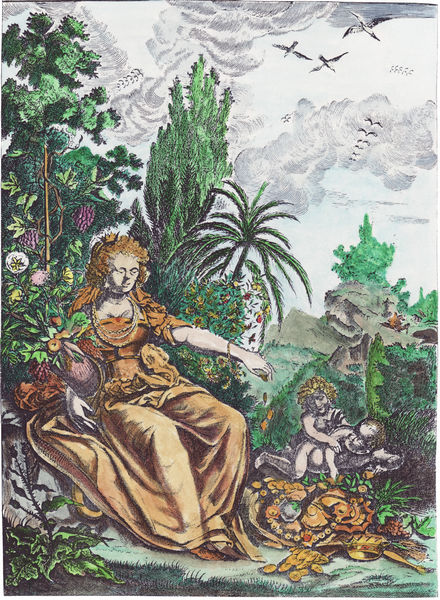
Barent Coenders van Helpen, L’Escalier des Sages, Cologne, 1693. © Adam McLean 1997-2017 (alchemywebsite.com). Used with permission.
Promises, promises.
False promises. Broken promises.
In marital relations, there is no greater sting, no act more likely to turn love to hatred, than the act of infidelity. The breach of trust. The breaking of a sacred bond. It is the ultimate betrayal.
Imagine for a moment the most hurtful of such betrayals. An adulterous affair, resulting in the birth of an illegitimate child.
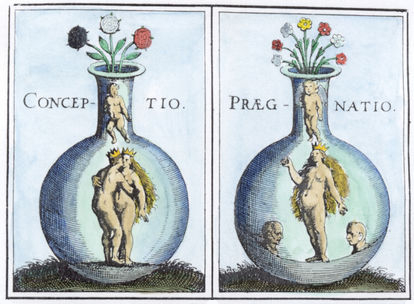
J.D. Mylius, Rosary of the Philosophers (Rosarium philosophorum sive pretiosissimum donum Dei), 1622. © Adam McLean 1997-2017 (alchemywebsite.com). Used with permission.
In medieval Latin, the word infidēlitas means unfaithful, disloyal, and treacherous. It implies a willful intent.
From ancient times, men have used overt sexual symbolism to communicate and record economic actions. Even when divorced from their origins in husbandry, we still use these sexual metaphors in our economic language. In accounting and finance in particular, many words are puns – they carry a double meaning.
Growth. Cycle. Period. Maturity. Seed. Deposit. Yield. Labour. Bond. And that’s only a handful.
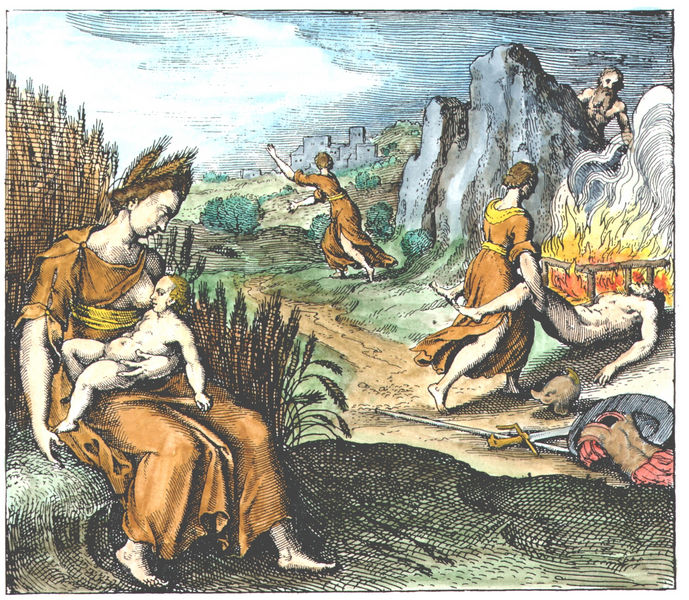
Michael Maier, Atalanta Fugiens: Emblemata Nova de Secretis Naturae Chymica, 1618. © Adam McLean 1997-2017 (alchemywebsite.com). Used with permission.
In New York, happiest among the financial alpha males is the big swinging dick. The term entered the lingua franca via Michael Lewis’ Liar’s Poker.[1]
It should come as no surprise then, that men have long used covert sexual symbolism to secretly communicate – and propagate – the art of economic deception, manipulation, and domination:[2][3][4]
Just like their oriental colleagues, the occidental alchemists expressed themselves in a twilight language. All the words, signs, and symbols, which were formulated to describe the experiments in their obscure “laboratories”, possessed multiple meanings and were only comprehensible to the “initiated”.[5]
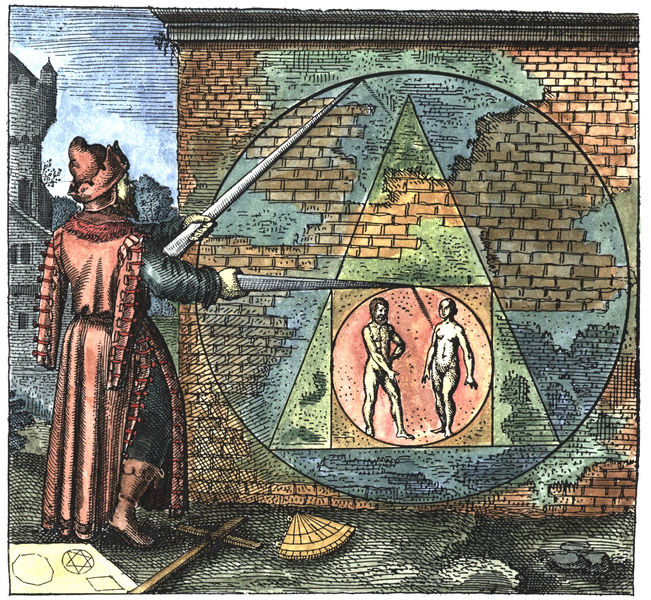
Square the Circle – Michael Maier, Atalanta Fugiens: Emblemata Nova de Secretis Naturae Chymica, 1618. © Adam McLean 1997-2017 (alchemywebsite.com). Used with permission.
“Make of the man and the woman a Circle,
of that a Quadrangle, of this a Triangle,
of the same a Circle, and you will have
the Stone of the Philosophers.”
So cryptic, so long disguised and so deeply embedded is it, that even men such as former governor of the Bank of England Mervyn King (The End of Alchemy) appear not to have understood the core conjugal metaphor:
[A]lchemy lies at the heart of the financial system; moreover, banking was, like alchemy, a medieval idea, but one we have not as yet discarded.
As Lord King remarks, the alchemy is “the belief that money kept in banks can be taken out whenever depositors ask for it”. This is a confidence trick in two senses: it works if, and only if, confidence is strong; and it is fraudulent. Financial institutions make promises that, in likely states of the world, they cannot keep.[6]
Banking – and money – is all about the making of promises.
Mutual promises.
A mutual exchange of promises.
Banking, and money, is all about the alchemical marriage of two opposite principals (principles) – a lender (male, active), and a borrower (female, passive) – who agree to a mutual, binding exchange of promises.
The primal act of banking, is the forming of a “bond” – a union of opposites – between a creditor (Sola ☉, Mars ♂), and a debtor (Luna ☽, Venus ♀).
Lots of them.
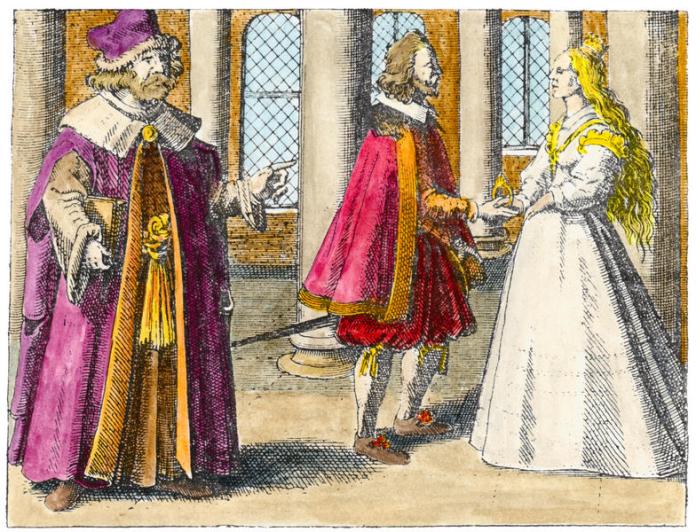
Arnold of Villanova (c.1240-1311), from Michael Maier, Symbola aurea mensae, 1617. © Adam McLean 1997-2017 (alchemywebsite.com). Used with permission.
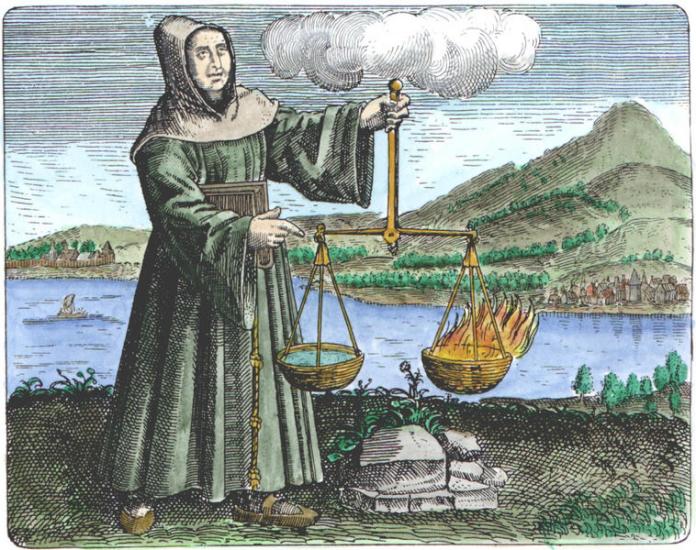
Roger Bacon (c. 1220-1292), from Michael Maier, Symbola aurea mensae, 1617. © Adam McLean 1997-2017 (alchemywebsite.com). Used with permission.
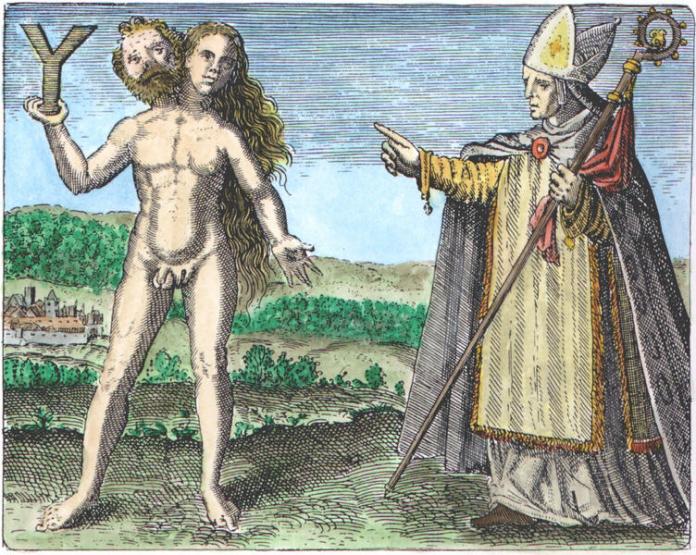
Albertus Magnus (c. 1200-1280), from Michael Maier, Symbola aurea mensae, 1617. © Adam McLean 1997-2017 (alchemywebsite.com). Used with permission.
The purpose of this bond – this union of opposites – is not to love each other, for better, for worse, for richer, for poorer, in sickness and in health, until death do us part. There is a higher purpose.
Reproduction.
The reproduction and growth of money.
The true purpose of this union of opposites, is the creation and multiplication of money … for the lender.
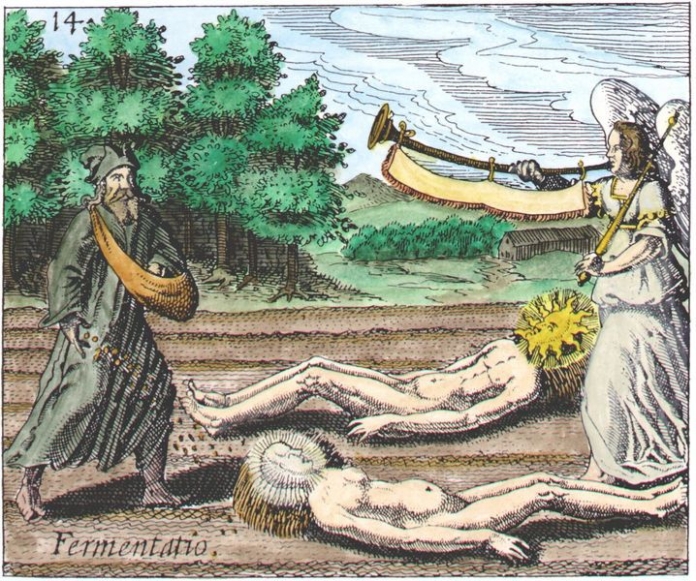
J.D. Mylius, Philosophia Reformata, 1622. © Adam McLean 1997-2017 (alchemywebsite.com). Used with permission.
In banking, the production and reproduction of money is achieved not by alchemy, or magic.
It is achieved by lying, and cheating.
Cheating females is the base principle that lies, by design, at the heart of the money system.
Cheating females, is what makes our world go round. It is the driving force behind a critical factor in all monopoly-monied economies: the “circulation”, the “flow”, or the “velocity of money”.
Cheating lies at the heart of the “creative destruction” phenomenon in capitalism, and the so-called “boom and bust” economic cycle.
Cheating females is also the cause of a phenomenon seen repeatedly, through all of recorded human history: the long term relationship between lending at “interest” (usury), and rising inequality.
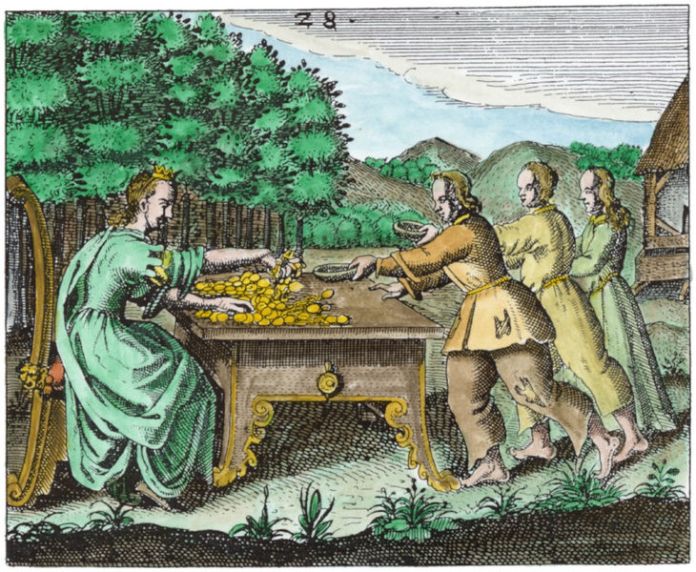
J.D. Mylius, Philosophia Reformata, 1622. © Adam McLean 1997-2017 (alchemywebsite.com). Used with permission.
The art of monetary cheating – along with its base sexual metaphor of male (lender) principle cheating the female (borrower) principle – can be traced back thousands of years to ancient Babylon, through the trade and migration routes, and the boastful claims to historicity, of a unique guild of artisanal merchants.[7]
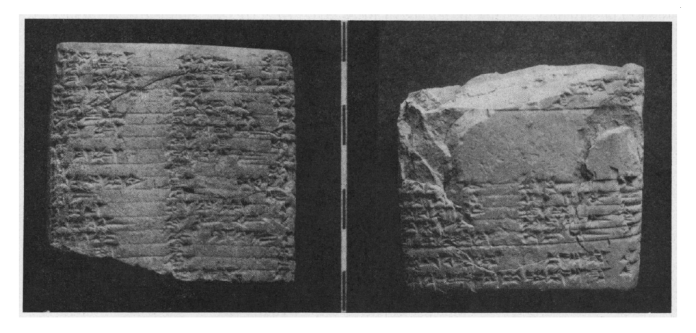
The same secret principle – a gross perversion of the hieros gamos (“Sacred Marriage”)[8] fertility rite – is found in the accounting records, in the scholarly, literary, and technical texts, and in the magico-religious artifacts of Mesopotamia, Egypt, Greece, the Roman Empire, Arabia, and the Far East.
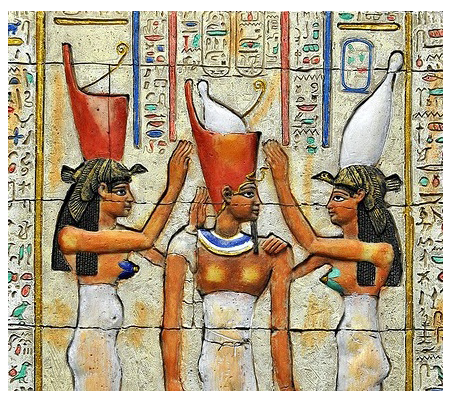
“The Crowns of Red and White combine into One.” – S.A. Weor, Treatise of Sexual Alchemy (1953)
It is found in the Babylonian Talmud and Jewish Cabala, in the code words and symbolism of Eastern and Western alchemy, and in the upaya (“method”, “trick”) of the Tantric Buddhist Kalachakra (“Time Tantra”) secret high initiation rites of medieval India.[9]
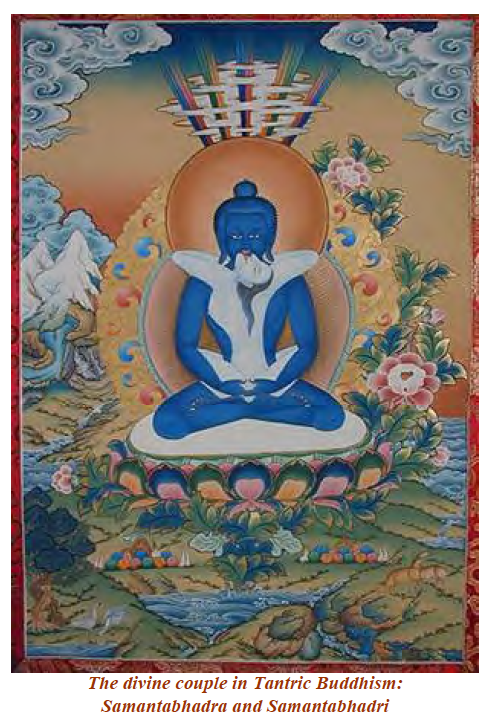
(Source: Trimondi, The Shadow of the Dalai Lama: Sexuality, Magic and Politics in Tibetan Buddhism)
Last of all, the same secret principle of monetary cheating is found in el modo vinegia, the medieval “Venetian method” of bookkeeping by double entry, still used as the foundation of banking and finance to this day.
“And the bookkeeper can be king if the public can be kept ignorant of the methodology of the bookkeeping.”[10]
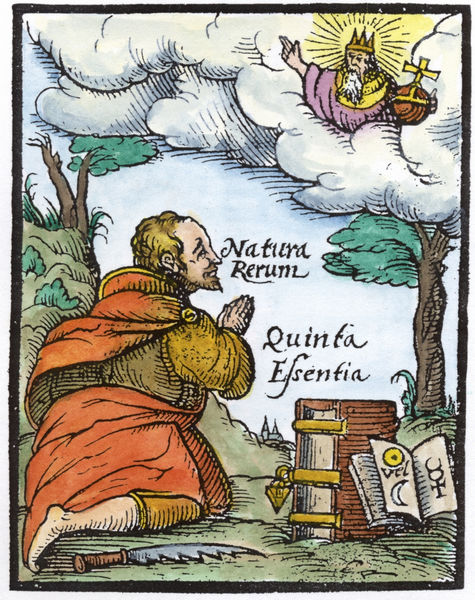
Johann Bernard Hildebrandt, De lapide philosophico, Halle, 1618. © Adam McLean 1997-2017 (alchemywebsite.com). Used with permission.
Cheating females – the Royal Art of “philosophers” – is all about producing inequality, by illusions of equality.
Since ancient times, the illusion of equality has been represented by the alchemical symbol of the androgyne (Mercury-Hermes ☿). It does not, as most believe, represent the union of male and female principles – two equal opposites – in a gender-neutralising, transcendent harmony.
The androgyne actually represents a mixture of male-female reproductive forces – the mixed “seed” of the man and woman – that is “possessed by a man”.[11]
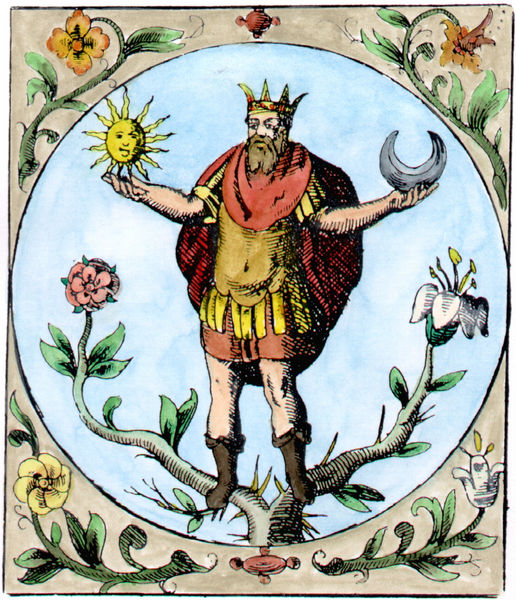
J.D. Mylius version of Basil Valentine ‘Azoth’ series, Philosophia Reformata, 1622. © Adam McLean 1997-2017 (alchemywebsite.com). Used with permission.
In the alchemy of banking, the illusion of equality is represented by a bookkeepers’ symbol (“$”, “€”, “£”, “¥”) called “money of account”. It does not, as most believe, represent the union of Assets and Liabilities – two equal opposites – in a “supply-demand” harmonising equilibrium.
“Money of account” actually represents a mixture of lender (male) and borrower (female) “deposits” – Assets (left side) and Liabilities (right side) … that is possessed by a Lender:
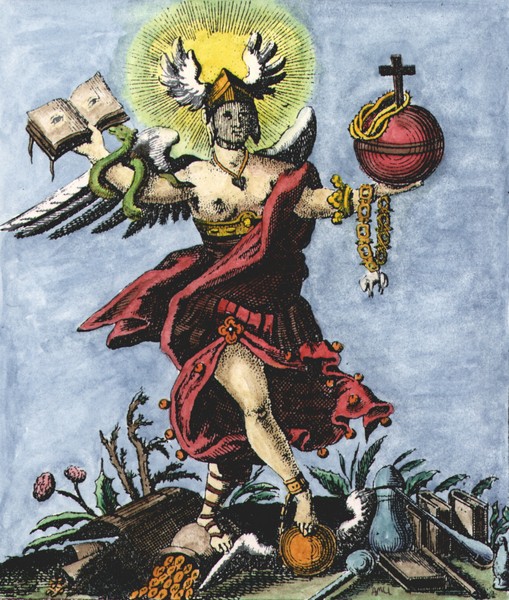
Note hands AND feet: Left = Assets (real wealth), Right = Liabilities (double-entry *book* debt) | J.A. Siebmacher, Das guldene Vleiss (“The Golden Fleece”), Nurnberg, 1737. © Adam McLean 1997-2017 (alchemywebsite.com). Used with permission.
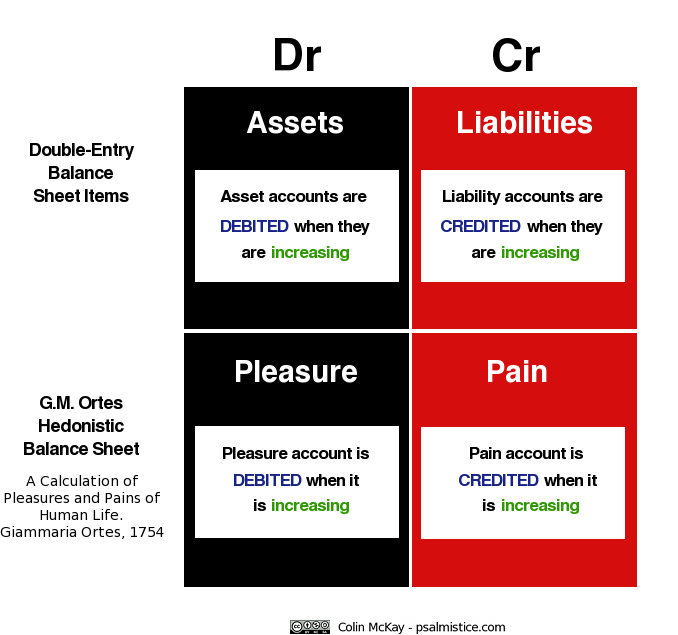
[T]he role of money [of account] as supplementer of value is concealed behind an apparent but deceptive power to guarantee equivalence. Moreover, the power of money enables the construction of previously unprecedented levels of wealth, and the possibility of new power relations for those with money and those without it.[12]
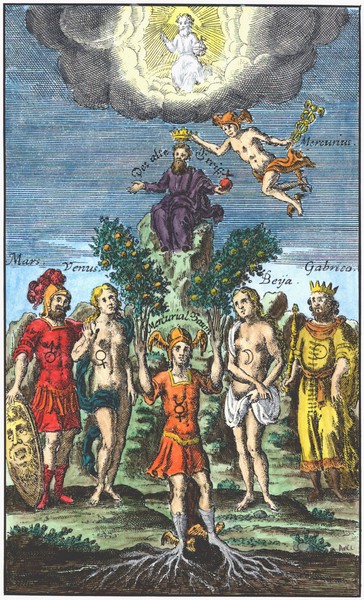
Adolph Christoph Benz, Philosophisce Schau-Buhne, 1706. © Adam McLean 1997-2017 (alchemywebsite.com). Used with permission.
How does the male (lender) principle cheat the female (borrower) principle?
By faking it.
The male cheats the female, by faking his – her – “deposits”.
The lender does not give the promised “seed” to the borrower.
He does the opposite.
Using a secret method, he actually steals hers.
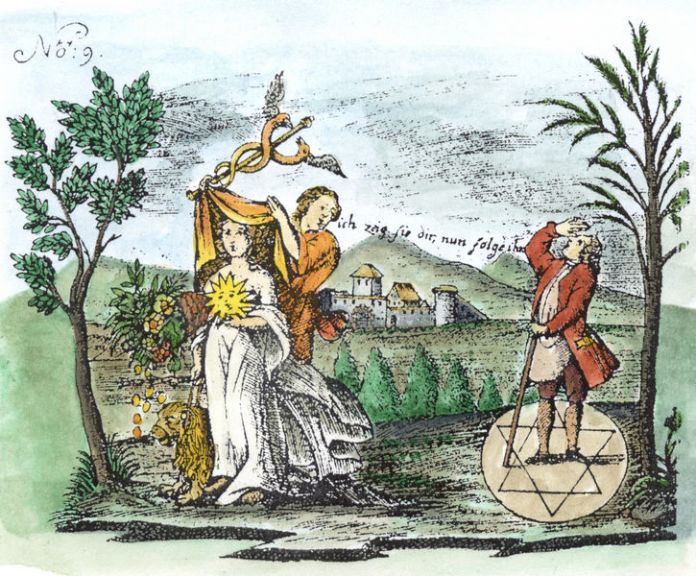
“I show her/it to you, now follow her/it.” | Hans Karl von Ecker, Freymäurerische Versammlungsreden der Gold- und Rosenkreutzer des alten Systems, Amsterdam, 1779. © Adam McLean 1997-2017 (alchemywebsite.com). Used with permission.
Following in the footsteps of Hermes “the Sage, the Babylonian”[13] – god of merchants, orators (eloquent liars), tricksters, imposters, hegemons and thieves – the lender actually “sucks money out of purses as the magnet attracts iron”:[14]
In the traditional Buddhist conception an embryo arises from the admixture of the male seed and the female seed. This red-white mixture is referred to by the texts as sukra. Since the fluids of man and woman produces new life [..] if the yogi succeeds in permanently uniting within himself both elixirs (the semen virile and the semen feminile), then eternal life lies in store for him. He becomes a “born of himself”, having overcome the curse of rebirth and replaced it with the esoteric vision of immortality. With the red-white mixture he attains the “medicine of long life”, a “perfected body”. Sukra is the “life juice” par excellence, the liquid essence of the entire world of appearances. It is equated with amrta, the “drink of immortality” or the “divine nectar”.[15]
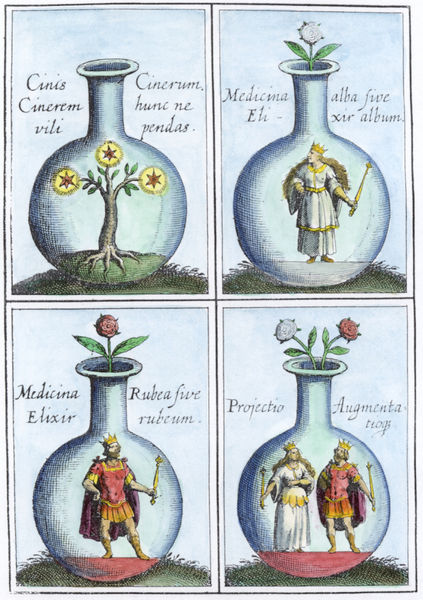
J.D. Mylius, Anatomia Auri, 1628. © Adam McLean 1997-2017 (alchemywebsite.com). Used with permission.
In the four highest secret initiation rituals of Tantric Buddhism, this “skillful” trick (upaya) is called the Vajroli method. It is considered “a veritable touchstone of the highest yogic skill”.
In the act of yuganaddha (fusion) with a “wisdom consort” (mudra) – lots of them – the tantric master sucks out the seed of the woman with his ‘cock’ :[16]
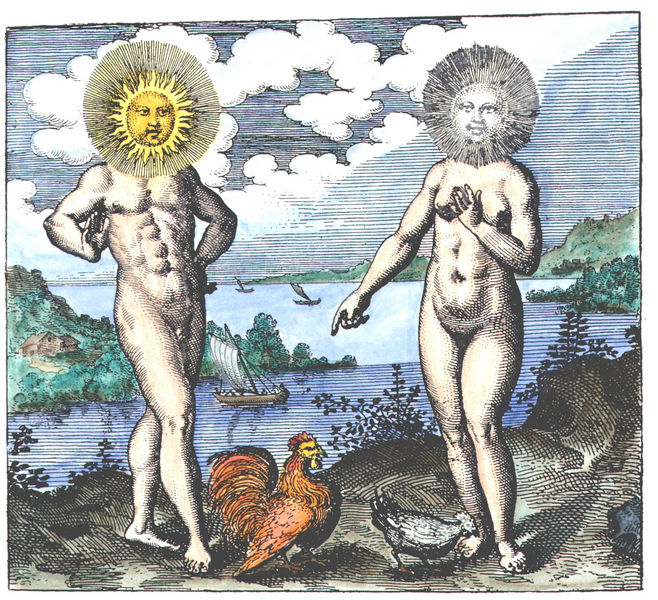
Michael Maier, Atalanta Fugiens: Emblemata Nova de Secretis Naturae Chymica, 1618. © Adam McLean 1997-2017 (alchemywebsite.com). Used with permission.
“After he has streamed forth,” Mircea Eliade quotes a text as saying, “he draws in and says: through my force, through my seed I take your seed — and she is without seed”. The man thus steals the seed of the woman under the impression that he can through this become a powerful androgynous being, and leaves her without her own life energy.
Some of the “initiated” even succeed in drawing up the semen feminile without ejaculating any sperm so as to then produce the yearned-for sukra mixture in their own body. The mastery of this method requires painful and lengthy exercises, such as the introduction of small rods of lead and “short lengths of solder” into the urethra.[17]
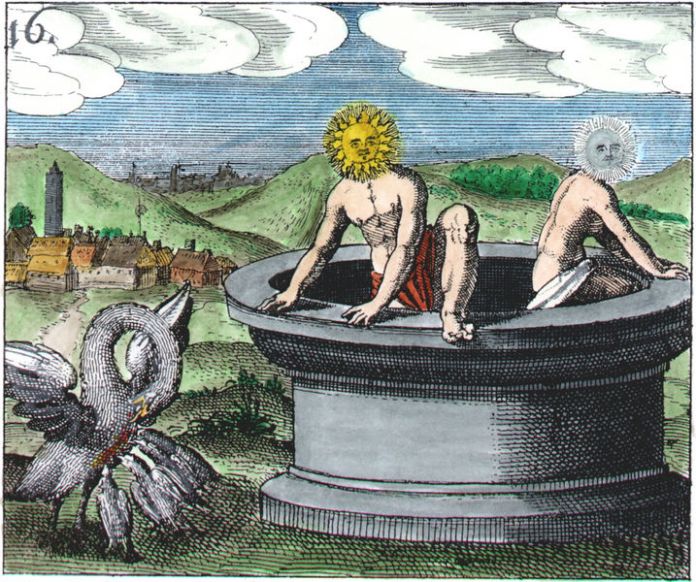
J.D. Mylius, Rosarium Philosophorum (“Rosary of the Philosophers”) series, Philosophia Reformata, Frankfurt, 1622. © Adam McLean 1997-2017 (alchemywebsite.com). Used with permission.
Now what happens if the yogi has not mastered the method of drawing back? .. [T]he adept may catch the sukra from out of the vagina in a vessel and then drink it. It is not rare for the drinking bowl to be made from a human skull. The Candamaharosana Tantra recommends sucking the mixture up with a tube (pipe) through the nose. If one sips the sukra out of his mudra’s genitals with his mouth, then the process is described as being “from mouth to mouth”. Without exaggeration one can refer to this drinking of the “white-red bodhicitta” as the great tantric Eucharist, in which semen and blood are sacredly consumed in place of bread and wine. Through this oriental “Last Supper” the power and the strength of the women are passed over to the man.[18]
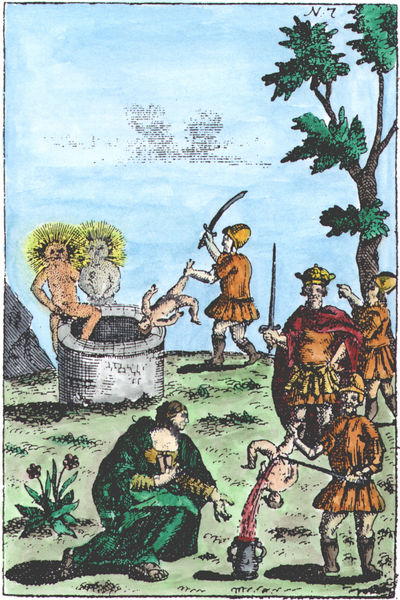
Abraham Eleazar, Uraltes chymisches Werck, ‘Flamel’, 1735. © Adam McLean 1997-2017 (alchemywebsite.com). Used with permission.
The frontispiece from Nicolas de Locques’ Les Rudiments de la Philosophie Naturelle (1665) perfectly illustrates the essence of the alchemical act. As the two “flames” (desire, lust) of Mercury-Hermes and Aphrodite-Venus “bond” – with the Sun ☼ (male) in the dominant position over the Moon ☾ (female), and her eyes blissfully wedded to the point of their “fusion” – the thieving trickster god steals her “waters” from right under her nose.
He uses her symbol (ancient Greek kteis, a pun meaning scallop shell and vagina) – held in his right hand (symbol of phallic power) – to perform the theft.

Mercury-Hermes stealing the “waters” (menses) of Aphrodite-Venus | Nicolas de Locques, Les Rudiments de la Philosophie Naturelle, Paris, 1665. © Adam McLean 1997-2017 (alchemywebsite.com). Used with permission.
This calculating thievery is celebrated by the Tantric Babhaha (“Free Lover”) in poetic verse:
In the sacred citadel of the vulva of
a superlative, skillful partner,
do the praxis of mixing white seed
with her ocean of red seed.
Then absorb, raise, and spread the nectar—
A stream of ecstasy such as you’ve never known.[19]
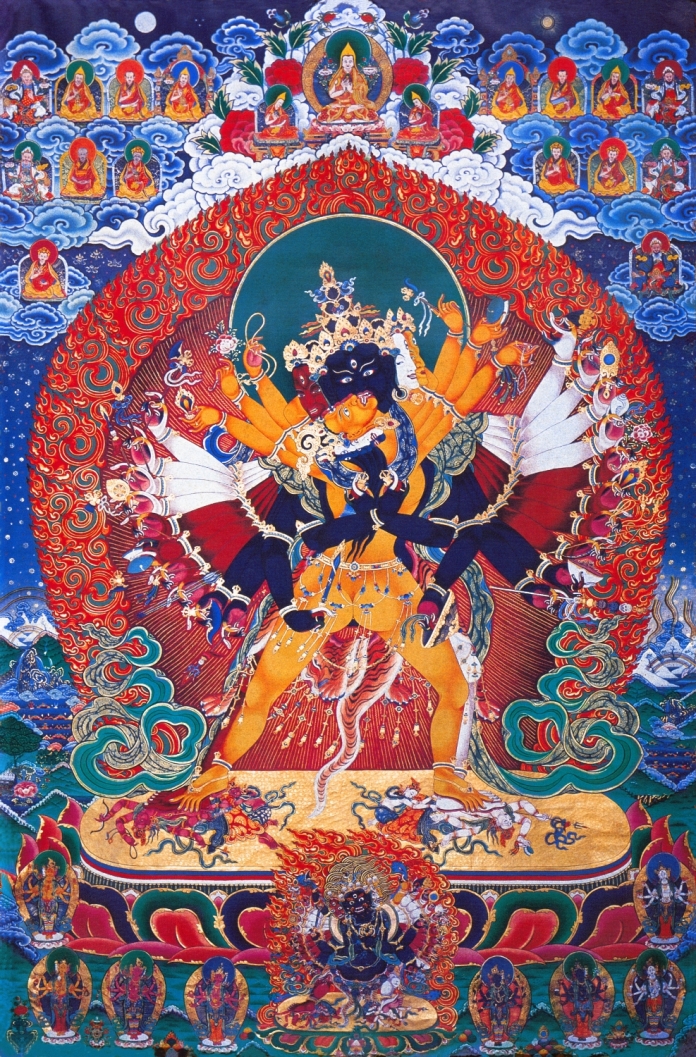
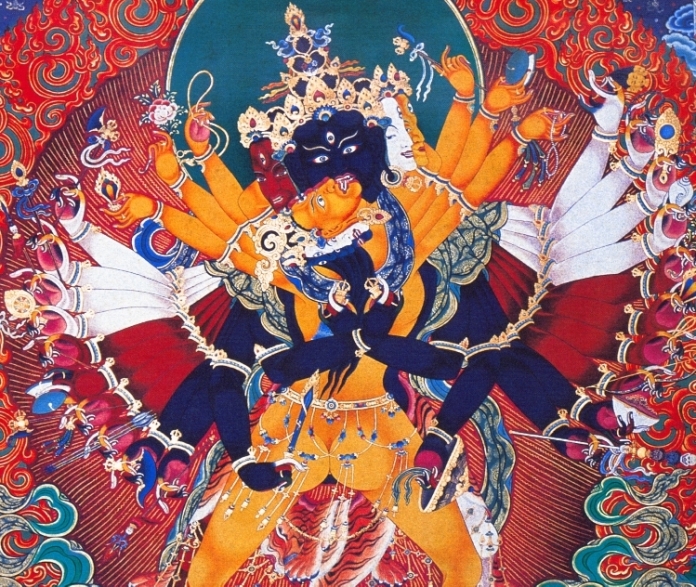
The deity Kalachakra and his consort, Kali Vishvamata. (Study carefully – click to enlarge)
The gesture of dominance with which the tantric master seals his consort during the sexual act is called the Vajrahumkara mudra: he crosses both hands behind the back of his partner, with the vajra [phallus] held in his right hand, and the gantha [vagina] in the left. The symbolic content of this gesture can only be the following: the yogi as androgyne is lord over both sexual energies, the masculine (symbolized by the vajra) and the feminine (symbolized by the gantha). In encircling (“sealing”) his wisdom consort with the androgyne gesture, he wishes to express that she is a part of his self, or rather, that he has absorbed her as his maha mudra (“inner woman”).[20]
In the alchemical doctrine of both East and West, the entire wealth of the cosmos is created out of the interaction of male and female genders – two equal opposites. By stealing the seed of the woman and uniting it with his seed within the temple of his own mystic and physical bodies, the tantric adept believes that he has at his disposal the secret birth-force of the female – a power that he both lacks and desires:
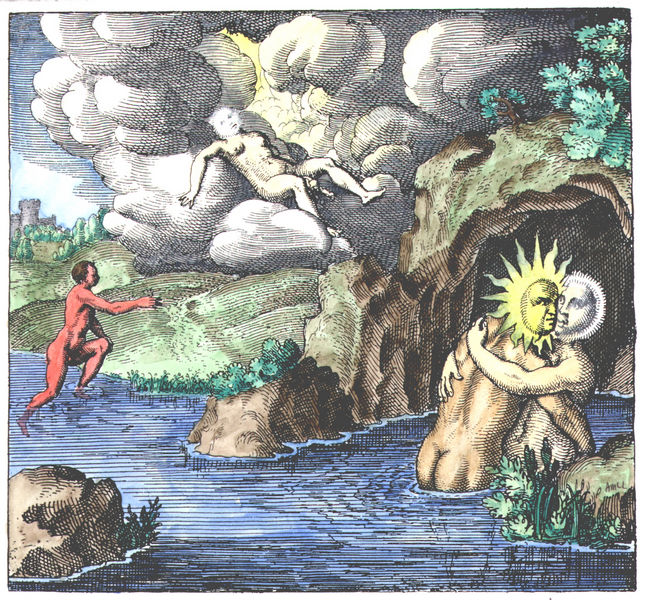
Michael Maier, Atalanta Fugiens: Emblemata Nova de Secretis Naturae Chymica, 1618. © Adam McLean 1997-2017 (alchemywebsite.com). Used with permission.
The tantric master uses a human woman [karma mudra], or at least an inana mudra [“spirit woman”] to create his androgynous body. He destroys her autonomous existence, steals her gynergy, integrates this in the form of an “inner woman” [maha mudra] and thus becomes a powerful double-gendered super-being.
“He absorbs the Mother of the Universe into himself”.[21]
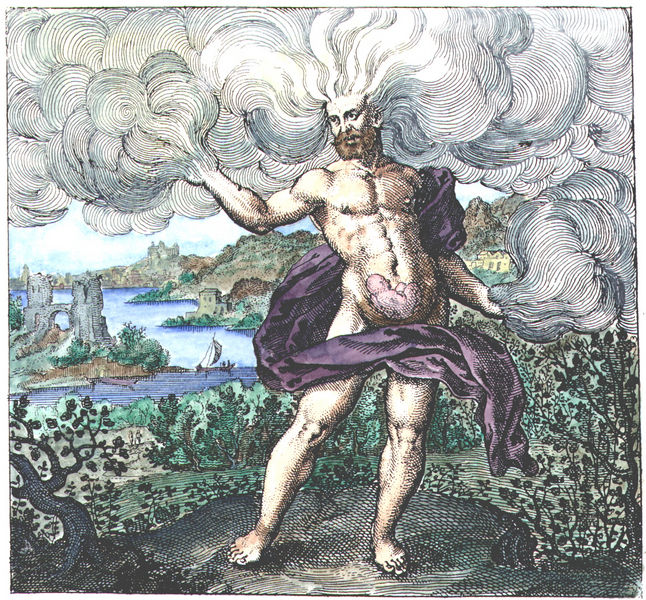
Michael Maier, Atalanta Fugiens: Emblemata Nova de Secretis Naturae Chymica, 1618. © Adam McLean 1997-2017 (alchemywebsite.com). Used with permission.
In the alchemical doctrine of bankers, the entire wealth of the economy is created out of the interaction of two opposite genders – Savers and Borrowers. By uniting their “deposits” within the temple of his own mystic and physical body – a monopoly banking △ system – the banking adept has at his disposal the secret birth-force of material wealth.
He now possesses legal ownership claims, on real world assets – the “collateral” he demands as “security” against failure to repay “his” “loans” – land, industrial “capital”, intellectual “property”, and the spent time and gynergy of human “labour”.
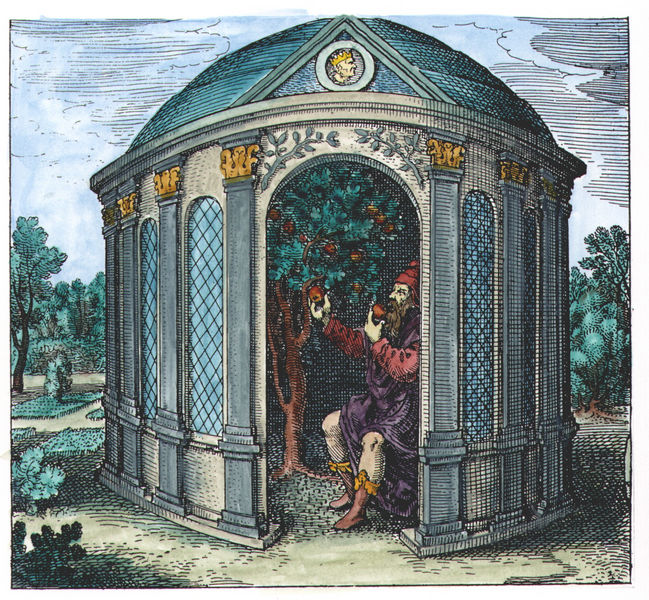
Michael Maier, Atalanta Fugiens: Emblemata Nova de Secretis Naturae Chymica, 1618. © Adam McLean 1997-2017 (alchemywebsite.com). Used with permission.
By cheating females – lots of them – the alchemist can become the “Grand Sorcerer” (Maha Siddha):
The goal of tantric androgyny is the concentration of absolute power in the tantric master, which in his view constitutes the unrestricted control over both cosmic primal forces, the god and the goddess. [..] Supernatural power gives the tantric master control over the whole universe. He can dissolve it and reestablish it. It grants him control over space and time in all of their forms of expression. As “time god” (Kalachakra) he becomes “lord of history”.[22]
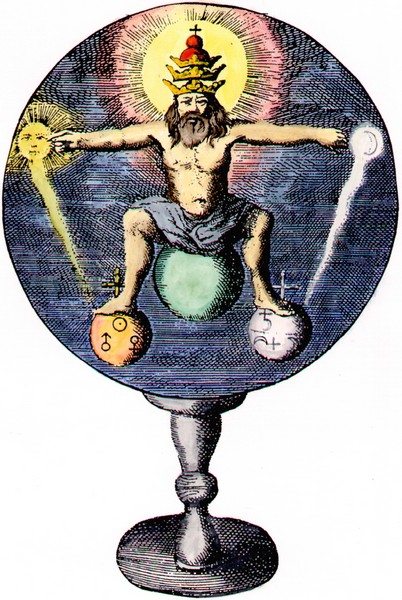
Johann de Monte-Snyders, Metamorphosis planetarum, Amsterdam 1663. © Adam McLean 1997-2017 (alchemywebsite.com). Used with permission.
This cheating process is precisely what happens in our ‘modern’, neo-medieval banking and money system. Or, to be more precise, their neo-Babylonian banking and money system. It is built on precisely the same Old Babylonian occult (Latin occultus: hidden, secret) sex magic principles.
The Unity (or Union) of Opposites.
And the Law of Inversion (or Reversal).
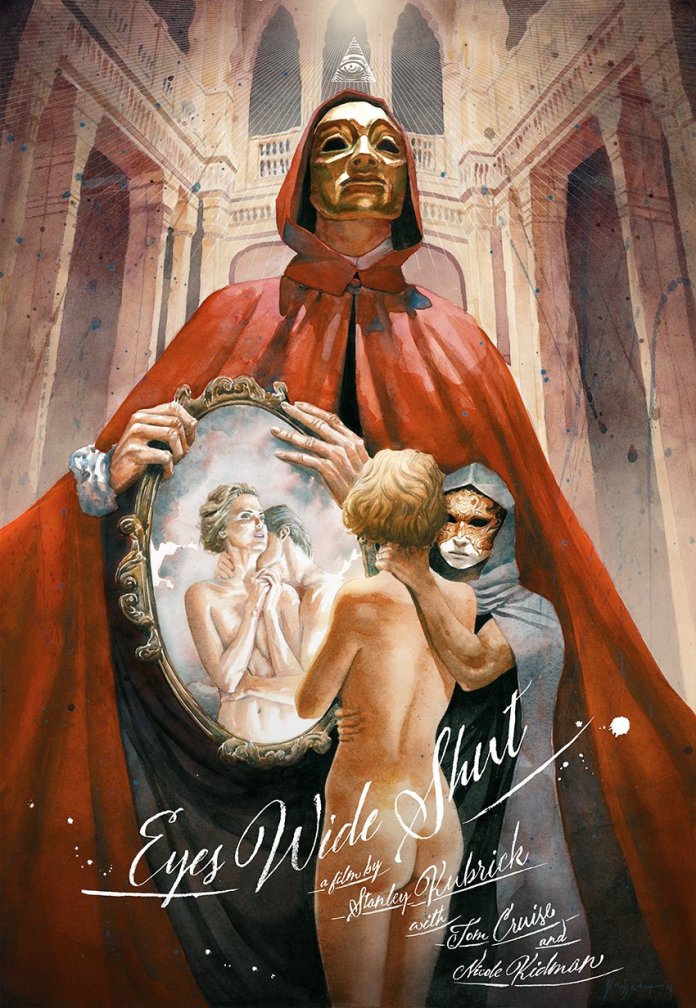
“Eyes Wide Shut” Artist Print (AP), J.S. Rossbach
In both East and West, the cheating method for sex magic – claimed to result in the spiritual and physical transformation of the (male) adept into an immortal Time Lord – at the expense of the female – is the same as the method for supposedly transforming base metals into pure gold:
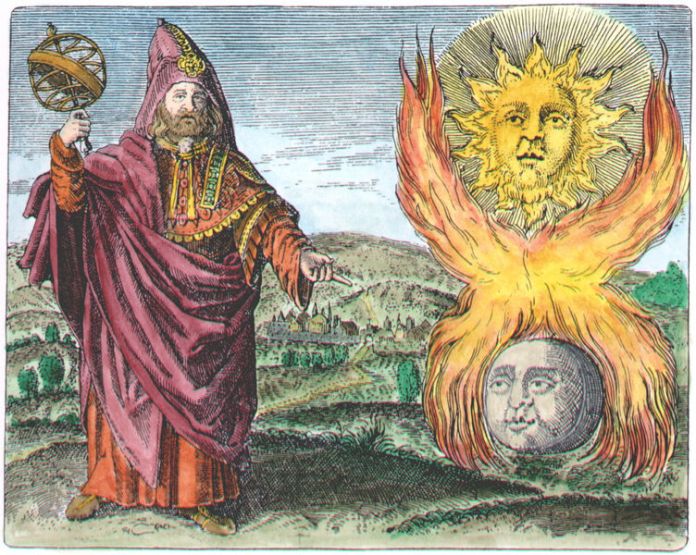
Hermes Trismegistus (“Hermes the Thrice Greatest”), from Michael Maier, Symbola aurea mensae, 1617. © Adam McLean 1997-2017 (alchemywebsite.com). Used with permission.
[P]recisely because most extreme estrangement from enlightenment is inherent to the “daughters of Mara”, because they are considered the greatest obstacle for a man and barricade the realm of freedom, according to the tantric “law of inversion” they are for any adept the most important touchstone on the initiation path. He who understands how to gain mastery over women also understands how to control all of creation, as it is represented by him. On account of this paradox, sexual union enjoys absolute priority in Vajrayana. All other ritual acts, no matter how bizarre they may appear, are derived from this sexual magic origin.
The Tibetan lama, Dragpa Jetsen [..] distinguishes three aspects of the royal art: the “Alchemy of life: he can make his life last as long as the sun and moon[; the] Alchemy of body: he can make his body eternally be but sixteen years old[; and the] Alchemy of enjoyments: he can turn iron and copper into gold”. These three experiments, then, primarily concern two goals: firstly the attainment of immortality, and secondly the production of gold, that is, material wealth.[23]
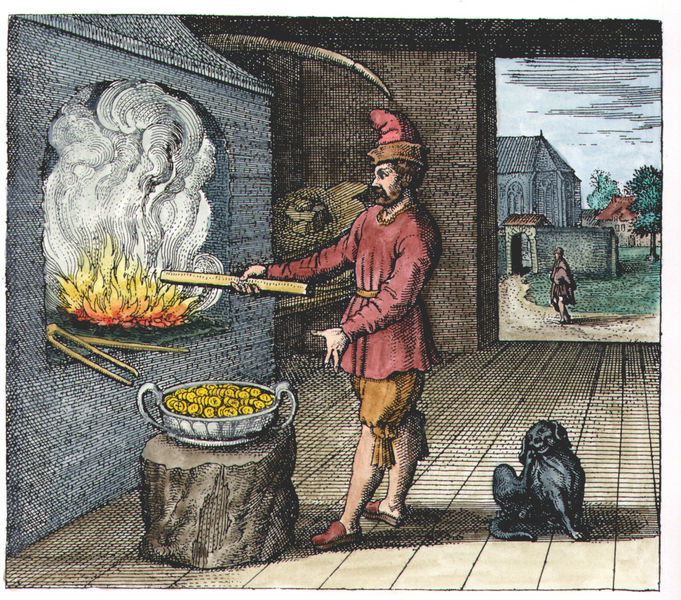
Michael Maier, Atalanta Fugiens: Emblemata Nova de Secretis Naturae Chymica, 1618. © Adam McLean 1997-2017 (alchemywebsite.com). Used with permission.
It should not surprise us to discover then, that the method long used by the male “time god” to steal the female’s gynergy, is precisely the same method long used by the male (lender) to cheat the female (borrower) in banking and trade.
Faking “deposits”.
As long ago as the dawn of the second millennium BC, the oldest written law code of human civilisation targeted this covert form of thievery:
Some evidence of the knowledge and previous existence of such practice of issuance of false receipts as against supposed valuables on deposit for safe-keeping clearly exists in the Law No. 7 of the great Hammurabi [1792 BC to 1750 BC] which same law was undoubtedly intended as a preventative to this sickness in society, which, even at that day, may very well have been the cancer that destroyed much that has been before. [..] The severity of the penalty and the placing of the law so high in the code leaves little doubt that it was directed against an evil that was by no means new…
“If a man buys silver or gold or slave, or slave girl, or ox or sheep or ass or anything else whatsoever from a [free] man’s son or a free man’s slave or has received them for safe custody without witness or contract, that man is a thief: he shall be put to death.”
The requisite of witnesses and contract attesting to the true facts of valuables on deposit, would to some extent obviate the danger of the goldsmiths, silversmiths or traders, involved in a transaction, creating receipts for valuables that did not exist, in safe custody or otherwise.[24]
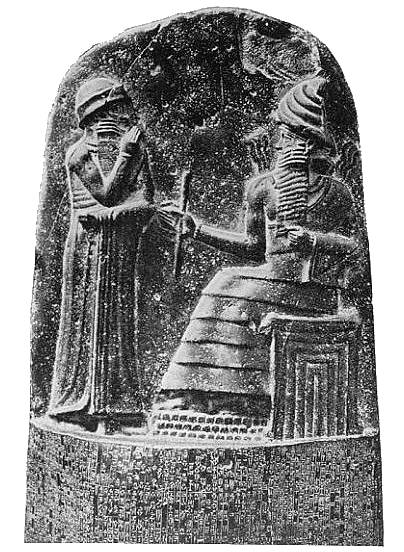
Figures at top of stele “fingernail” above Hammurabi’s Code of Laws, Old Babylonian Period, c. 1792 – 1750 BC. (Milkau Oberer Teil der Stele mit dem Text von Hammurapis Gesetzescode 369-2)
The death penalty must have motivated the cheating “time gods” to alter their method. As we will see, some six hundred years after King Hammurabi, the alchemists of Babylon were secreting a recipe to create the appearance of silver – their international trade (and thus, the accepted royal) standard, against which all other commodities were measured. The method, and especially the ingredients of this secret recipe, has far-reaching, explosive – and truly enlightening – explanatory powers.
Around two thousand years later, the cheating time lords were still practicing their secret method in and around what remained of the fallen and fragmented Roman Empire:
I summon today
All these powers between me and those evils,
Against every cruel and merciless power
that may oppose my body and soul,
Against incantations of false prophets,
Against black laws of pagandom,
Against false laws of heretics,
Against craft of idolatry,
Against spells of witches and smiths and wizards,
Against every knowledge that corrupts man’s body and soul…
Saint Patrick’s Breastplate, c. 433 AD
[This prayer also known as The Cry of the Deer (i.e., the “hart”)]

Palladius Patricius (St. Patrick) chases the ‘snakes’ out of Hibernia (Ireland).
In 620 AD the Roman emperor Diocletian issued a decree ordering to destroy all alchemical manuscripts for he was afraid of devaluation of the currency by false silver and/or gold made by alchemists.[25]
Almost a thousand years after that, at the dusk of the medieval era and the dawn of ‘modern’ commercial banking, they were still at it:
Francesco de’ Medici, a prince of the Medici, eldest son and heir to Cosimo I, should have been born with the golden apple of fortune clutched firmly in his hands. What went wrong? Why did he end his life loathed and feared by the people of Florence, amid whispers he had been poisoned by his own brother? [..] [I]n in letters and documents of the day Francesco is universally described as .. obsessed with alchemy.[26]
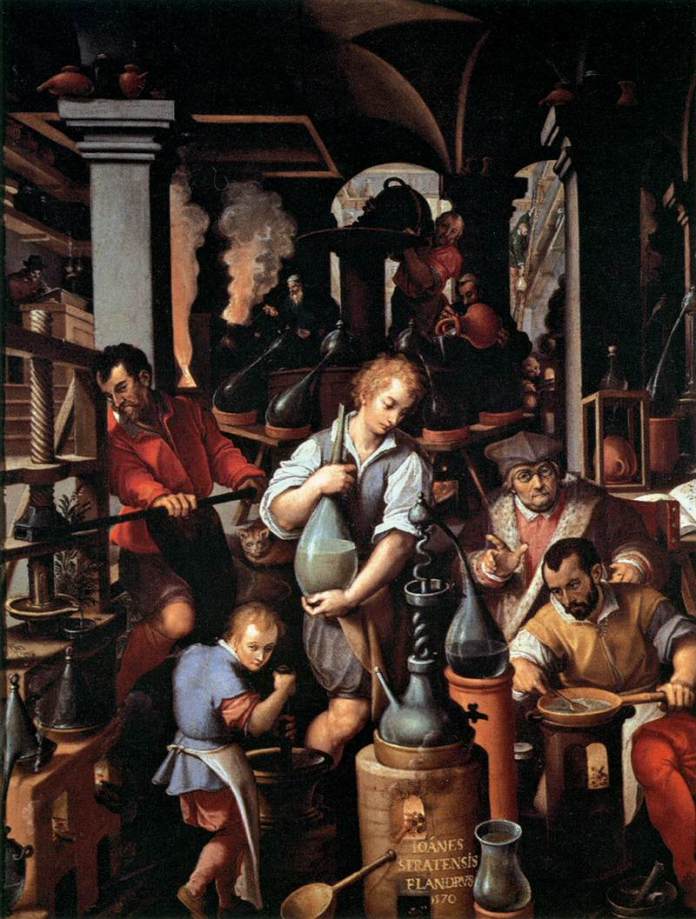
Joannes Stradanus (Jan van der Straet) – Francesco I de’ Medici in The Alchemist’s Laboratory, 1570.
Thurneisser or Thurneysser, as well as five other spellings, was born in Basel in 1530. His father was a goldsmith. Arrested for selling gilt lead as gold, Thurneisser fled Basel [..] He wrote on chemistry, alchemy, meteorology, pharmacology and medicine, making it up as he went along. History sees him now as a flamboyant charlatan.[27]
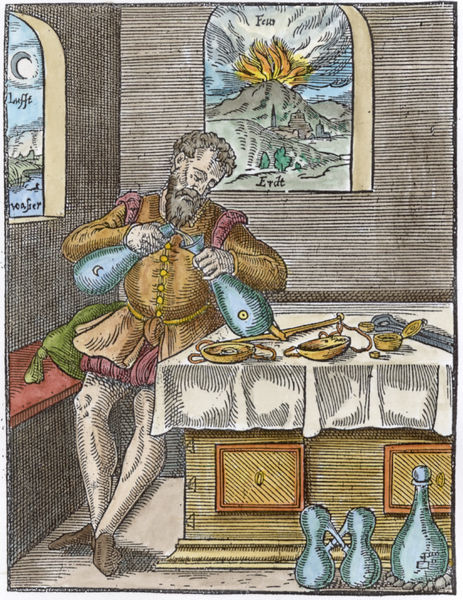
Leonard Thurneisser, Archidoxa, 1575. © Adam McLean 1997-2017 (alchemywebsite.com). Used with permission.
Today, we “females” no longer use silver or gold as common money. Nor do we use cuneiform or paper I Owe You’s – written records of a Promise to Pay – receipts issued by ‘smiths for our gold and silver “deposited” with them for safe-keeping.
Instead, almost all of the “money” that we use today, is really just an electronic bookkeeping record of a male promise to pay us the government’s legal tender – cash notes and coins – “on demand”.
We pay the male rent – renamed as “account keeping fees”, “charges”, and “interest” – to have electronic “access” to his “payments system”; meaning, a system allowing us to send a request for a change in his bookkeeping records.
We believe, or unthinkingly assume, that the male – a privileged monopoly “agent” of the Sovereign – actually has a “supply” that is equal to his promises to pay out the Sovereign’s real money, stored securely in his safe.
He does not actually discharge his “promise” – a binding, legal obligation – to pay us real, physical Sovereign money, unless we “demand” it.
But he would really, really prefer that we didn’t:
In case you thought banks lend money – they take deposits and lend money – you’re wrong. Legally, they do not take deposits, they borrow from the public. The expressions in banking are designed to mislead what’s really happening…
What is a bank account? It is not a deposit. What is it? It is a record of the bank’s debt to the public; it is a record of the bank’s debt to the new borrower, and they’ll show you the record of how much money they owe you. That’s it. They don’t pay up.[28]
So what happens when we “spend” the “money” in the “account” that we are renting access to?
The male “time god” simply changes hisstory in his books.
He now records that his debt to one female is less, and his debt to another female – or, the debt owed by his fellow cheating time lord in another temple of their cabal – is more.
He calls that a “payment” or “transfer”. Even though no one has actually been paid out any real money.
He and his fellow cheating time lords have simply shuffled their stories of their undischarged promises – their Sacred Marital obligations – to give the cat the cream.
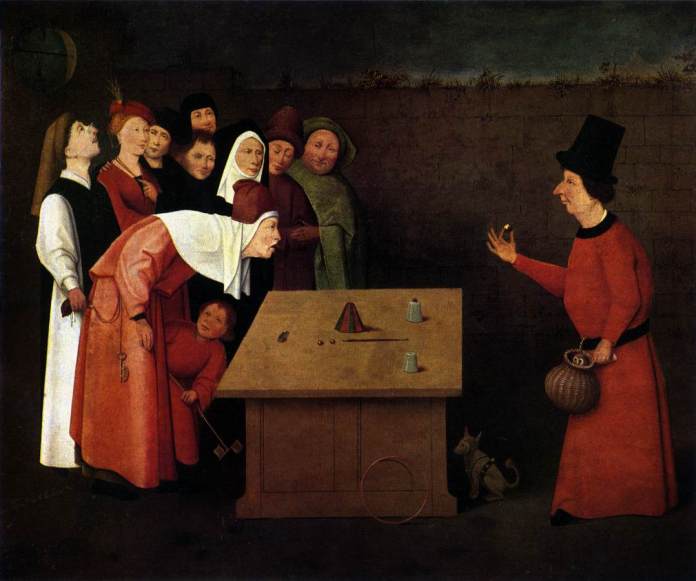
“The Conjurer,” painted by Hieronymus Bosch (between 1496 – 1520). The painting accurately displays a performer doing the cups and balls routine, which has been practiced since Egyptian times. The shell game does have some origins in this old trick. The real trick of this painting is the pickpocket who is working for the conjurer. The pickpocket is robbing the spectator who is bent over. (Source: Wikipedia)
In ‘modern’ banking, the counterfeiting of “deposits” is done using the “Venetian method” of bookkeeping by double entry. For all its fabled pretences to mathematical precision, “balance”, and objective impartiality, the art of bookkeeping – the keeping of “accounts” – is really nothing more than story-telling.
With “positive” and “negative” numbers added.
(Did you see what I did then? Loθok again.)
Most importantly, “money” by double entry is always a story of two opposite perspectives … told from only one perspective.
The bookkeeper’s.
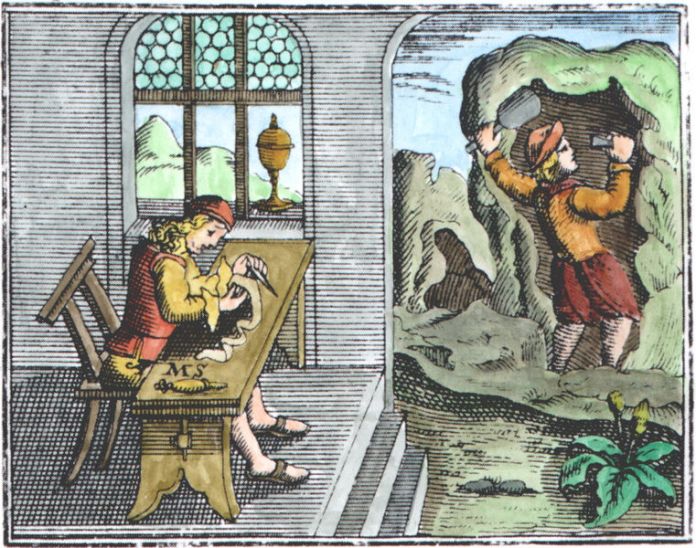
Andreas Orthelius’ commentary on Sendivogius’ Novum Lumen Chymicum (“New Chemical Light”), 1624. © Adam McLean 1997-2017 (alchemywebsite.com). Used with permission.
So his double story-telling has lots of opportunity for “skillful” tricks of word-play.
Puns.
Words with double, or even multiple meanings:
Sumerian cuneiform and Egyptian hieroglyphs were originally based on punning systems. Punning has been credited as the fundamental concept behind alphabets, writing, and even human civilization.[29]
In the world’s first empirical test to discover what banks really do when they “issue” a “loan” of “money”, Professor Richard Werner has proven that the trick of the ‘modern’ cheating time lord is … a pun.
He just names the record of his undischarged debt – his promise – as her “deposit”.[30]
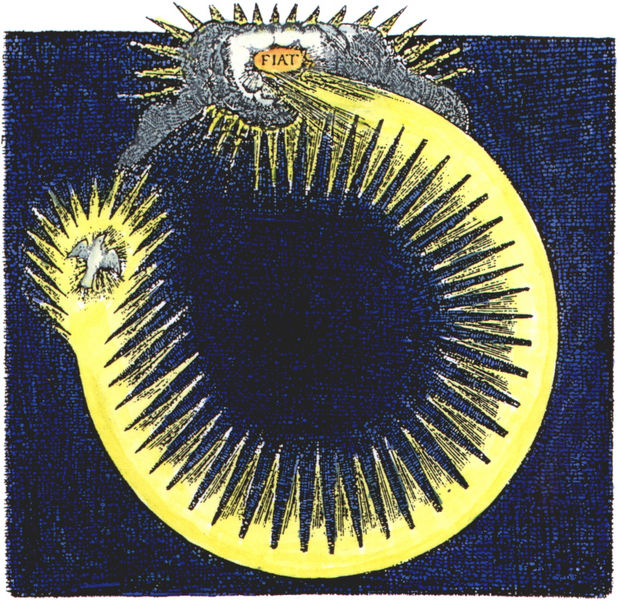
Robert Fludd, Utriusque Cosmi Maioris scilicet et Minoris Metaphysica Physica Atque Technica Historia, 1617-1621. © Adam McLean 1997-2017 (alchemywebsite.com). Used with permission.
The Sacred Word “deposit” … is a pun.
From the perspective of the female renter of access to “money”, it appears to be her money – the money that he promised to give her. It appears to “perform” just like the real thing.
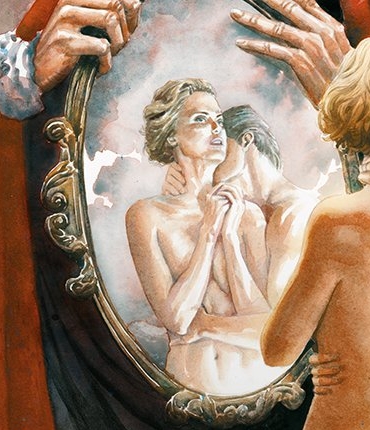
But from the perspective of the cheating time lord, it is just a record – a reflection, a re-presentation – of his unpaid debt. His false promise. The source of his power, to “draw blood” from “easy meat” … from, in his own words, a “Babylonian whore”.[31]
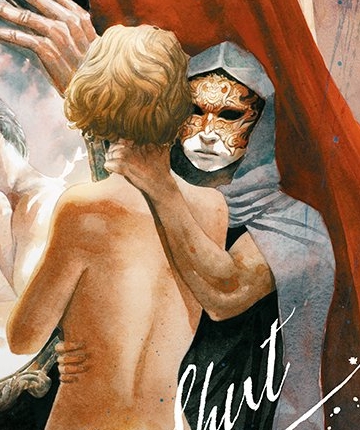
At all times, all of these “deposits” (and a few drops of real money) are stored within the temple of his mystic and physical body – the monopoly banking debt-“money of account” △ system.
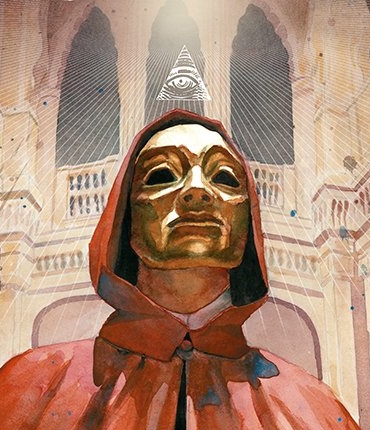
The male never discharges his debt – his promise – unless she demands to have it in her “purse”.
If and when she does, he might not be able to do it:
Banks promise to return money today, when most is tied up until tomorrow or the day after. They rely on the trust of customers collectively not to call their bluff. When that trust is lost, creditors run, promises cannot be met and the banking system collapses.[32]
There is nothing the cheating time lord fears more, than having lots of “females” – karma mudras – collectively exercising their Sacred Right and demanding to have the money – the real money – that he promised to pay:
[I]n India the flowing of the male seed into “the fiery maw of the female sexual organ” is still today regarded as a sacrificium and therefore feared as an element of death.[33]
[E]jaculation is equated simply with death. [..] “The fear of losing body fluids leads not only to retention, but to attempts to steal the partner’s fluid (and the fear that the partner [karma mudra] will try the same trick) — yet another form of competition”.[34]
The drawing up of sperm by a woman is viewed by a tantric yogi as a mortally dangerous theft and a fundamental crime.[35]
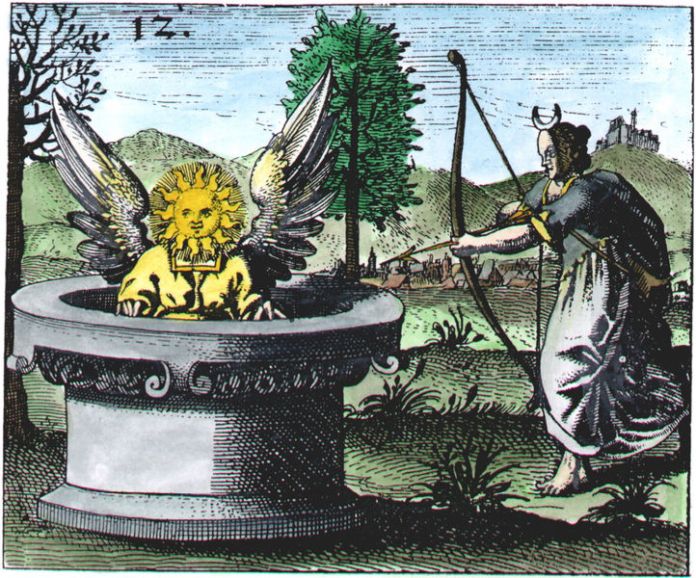
J.D. Mylius, Rosarium philosophorum (Rosary of the Philosophers) series, Philosophia Reformata, Frankfurt, 1622. © Adam McLean 1997-2017 (alchemywebsite.com). Used with permission.
For the lying cheating banker, this means that the Royal Art is a delicate balancing act. If the females ever wake up to his “confidence trick”, and collectively demand the real Sovereign money, then he is royally f****d.
He is always living on the edge, of economic life and death:
For a Buddhist Tantric the retention of the male seed is the sine qua non of the highest spiritual enlightenment. [..] As soon as a person begins to experience sexual desire, it starts to flow out, drop by drop [..] The destination of the sperm’s journey within the body is the tip of the penis. Here, through extreme meditative concentration, the adept collects the lust [..] “Through this, the act obtains a cosmological dimension. … It becomes the means of attaining enlightenment (bodhi)”. “Delight resides in the tip of the vajra [penis]”…[36]
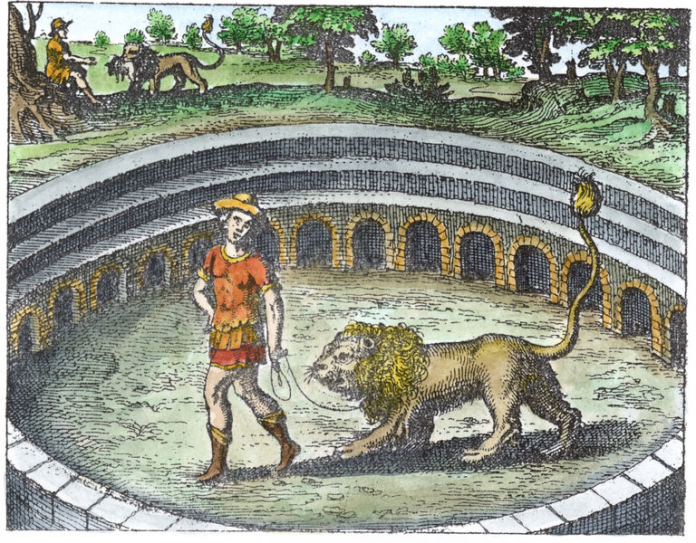
Michael Maier, Viatorium, Oppenheim, 1618 © Adam McLean 1997-2017 (alchemywebsite.com). Used with permission.
J.D. Mylius, Rosarium Philosophorum (“Rosary of the Philosophers”) series, Philosophia Reformata, Frankfurt, 1622. © Adam McLean 1997-2017 (alchemywebsite.com). Used with permission.
The Sanskrit term for alchemy is Rasa-vada. Rasa means ‘liquid’ or ‘quicksilver’. Quicksilver was considered the most important chemical substance which was made use of in the “mystic” experiments, both in Europe and in Asia. The liquid metal was employed in the transformation of materials both in the east and the west, in particular with the intention of producing gold. In the Occident it bore the name of the Roman god, Mercury. The Kalachakra Tantra also mentions quicksilver at several points. The frequency with which it is mentioned is a result of its being symbolically equated with the male seed (bodhicitta); it was, in a manner of speaking, the natural-substance form of the semen virile.
It is a characteristic of quicksilver that it can “swallow” other substances, that is, chemically bind with them. This quality allowed the liquid metal to become a powerful symbol for the tantric yogi, who as an androgyne succeeds in absorbing — i.e., “swallowing” — the gynergy of his wisdom consort.[37]
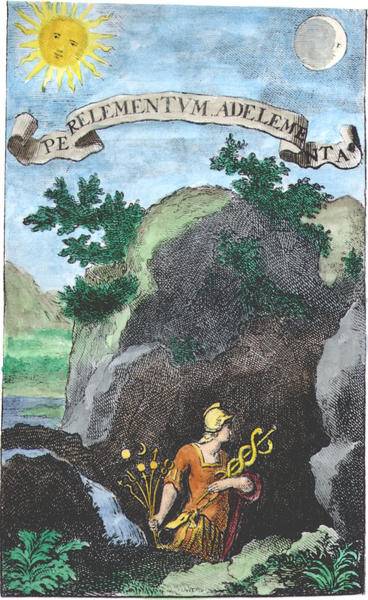
Baro Urbigerus, Besondere chymische Schrifften, 1705. © Adam McLean 1997-2017 (alchemywebsite.com). Used with permission.
The alchemist plays a dangerous game. In order to transform himself into the Master of the Universe – having “absolute power” and “unrestricted control over both cosmic primal forces, the god and the goddess” – he must “conquer” all the “females”.
To do this, he must continually “grow” the size of his undischarged promises to pay out real Sovereign money (cash notes and coins).
In bankers’ words, he must “expand his balance sheet” … until all the “females” are firmly, irredeemably in his debt.
This is nothing less than an alchemical, misogynist metaphor for growing an enormously “big swinging dick”.
Given that borrowers’ debts are recorded as the bankers’ Assets, to expand his balance sheet means that – from his perspective – he is growing an enormously “big black swinging dick”.
We “females” see a growing debt as our being “in the red”.
The “time god” sees that same debt, for him, as being “in the black”.
As we will see, according to the Law of Inversion the alchemist believes that he should begin with the worst substances, in order to “transform” them into the best. Indeed, the very first step in an alchemical experiment is “located within a context of sacrifice, death and the color black”, and is called nigredo – “blackening”. So the bankers’ cynical creed is not only malevolently misogynist; paradoxically, it is also rapaciously racist … against black people.
Professor Werner’s world-first empirical study has shown that every time a lying cheating “time god” makes a new false promise to pay – every time he “issues” a new “loan” of fake “money of account”, and does not discharge any real money – this is precisely what happens.
His balance sheet – his metaphorical ‘cock’ – grows bigger:
For firms without a bank licence, the disbursement of the loan is from funds elsewhere within the firm. Thus there is an equal reduction in balance of another account from which the lent funds came from. Therefore, the balance sheet shrinks again. There is no overall change in the total size of the balance sheet.
However the story is quite different for the bank. Surprisingly, we find that unlike the other firms whose balance sheets shrank back in Step 2, the bank’s accounts seem in standstill, unchanged from Step 1. The total balance sheet remains lengthened. No balance is drawn down to make a payment to the borrower.[38]
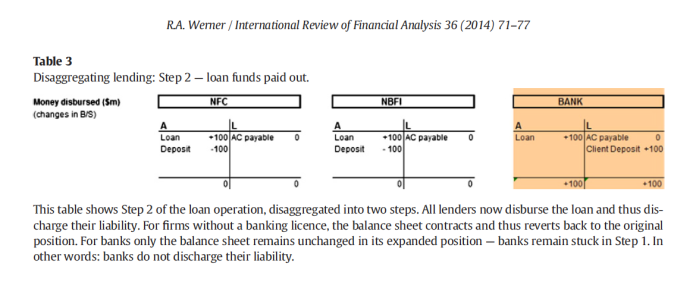
“For banks only the balance sheet remains unchanged in its EXPANDED position .. In other words: banks do not discharge their liability.”
From Vajrayana comes the striking saying that “A yogi whose member is always hard is one who always retains his semen”.[39]
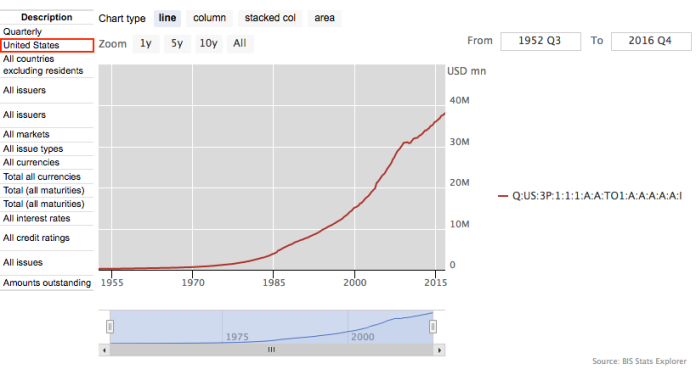
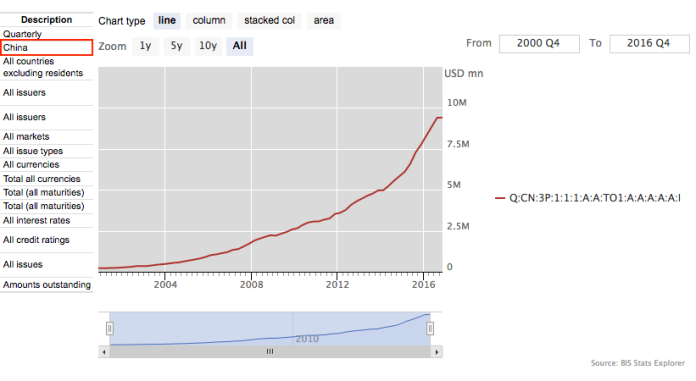
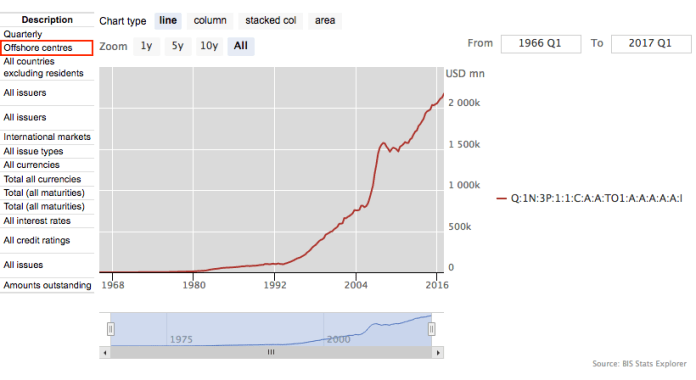
These lying cheating time lords have long told a romantic story of their past, and present. This fairy tale “account” says that theirs is only a neutral, benevolent, guiding hand – the Invisible Hand – in the reproductive affairs of others. Just like a high priest, officiating at the Sacred Wedding of two opposites. His divine intermediation and blessing on their union is necessary to ensure that the gentle rains of prosperity, security and happiness will fall on both of them … or so hisstory goes.
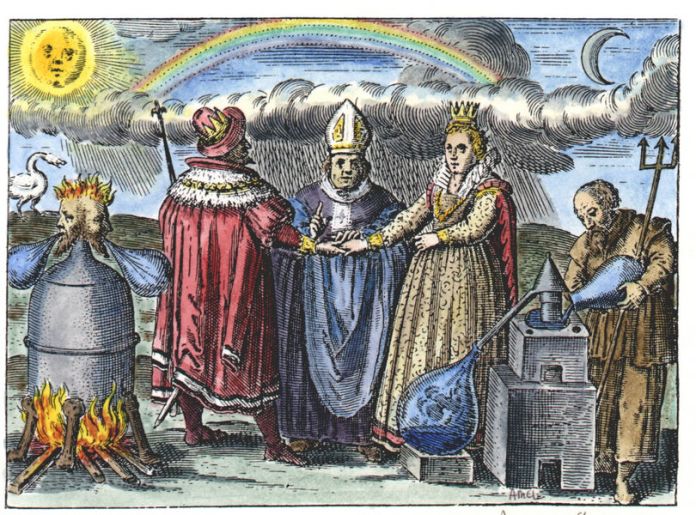
Sixth Key of Basil Valentine (1599), in Michael Maier, Tripus Aureus (Golden Tripod), 1618. © Adam McLean 1997-2017 (alchemywebsite.com). Used with permission.
Over many centuries, these invisible-handed banking high priests – along with their most-favoured choir boys in the economic theory profession – have conjured up lots of abstract word-pairs to describe this “productive” union of two opposites.
Savers and Borrowers. Patient and Impatient. Investors and Entrepreneurs. Sellers and Buyers. Producers and Consumers. Exporters and Importers. External and Internal. Public and Private. And that’s just a handful.
These abstract word-pairs serve the purpose of creating a false appearance – an illusion – of equality in the union of two opposites, with the banking high priest merely “serving” the community as the trusted, Fatherly intermediary.
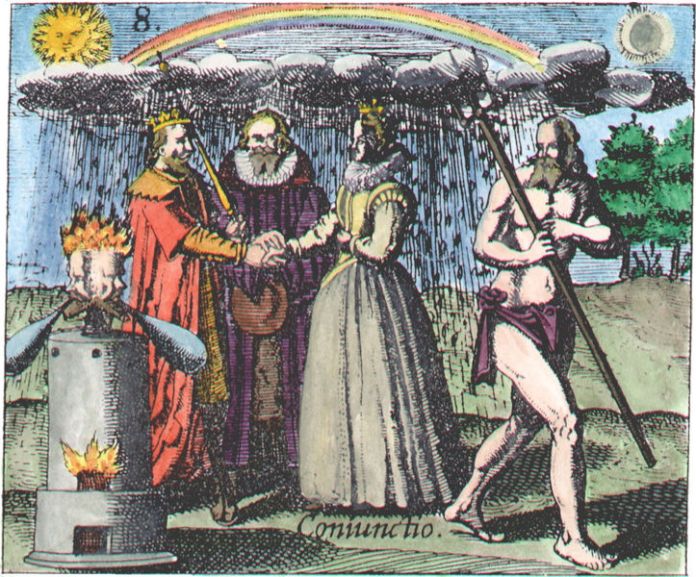
J.D. Mylius, Philosophia Reformata, 1622. © Adam McLean 1997-2017 (alchemywebsite.com). Used with permission.
The reality is rather different.
As with most effective deceptions, there is some truth in this tale. One part of time lord operations once was – and still is, in a manner of speaking – acting as an intermediary between so-called “Savers” and “Borrowers”: receiving “deposits” for “safe-keeping” (legally, borrowing) from one, and “lending” to the other.
But even here, the appearance of equality between these two abstract opposites, is just an illusion. A clever trick of word-play.
The banking high priest is practicing “Time manipulation” – or more accurately, date-of-birth shuffling – with all the “accounts” of his promises to pay real money.
He is able to “create” and multiply real wealth for himself, using the “flows” between all the opposites.
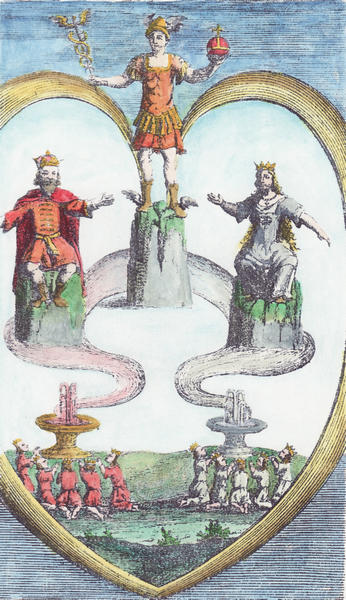
Benedictus Figulus, Thesaurinella olympica, 1682. © Adam McLean 1997-2017 (alchemywebsite.com). Used with permission.
The banking high priest calls this date-of-birth hustling procedure “maturity transformation” – of “term” “deposits”.
With one hand, he borrows from “depositors” for a short period of time.
With the other hand, he lends to “borrowers” – who are instantly “transformed” into “depositors” too – for a long period of time:
By doing this, banks transform [their] debts with very short maturities (deposits) into credits with very long maturities (loans), and collect the difference in the [usury] rates as profit.[40]
There is no “magic” in any of this. The cheating time lord is simply abusing his privileged, monopoly position. Because he controls the bookkeeping records of large “stocks” of his promises, and constantly re-writes hisstory of his promises – that is, his story of the “flows” of his promises between his customers’ “accounts”, and, between those and the “accounts” written by his fellow “time gods” at other temples – he is able to gain real wealth for himself by cheating all the “depositors”.
He will only get caught if too many “account holders” (renters) start to smell a rat, and decide, at the same time, to demand the real deal – legal tender cash notes and coins – that the cheating time lord has promised to pay.
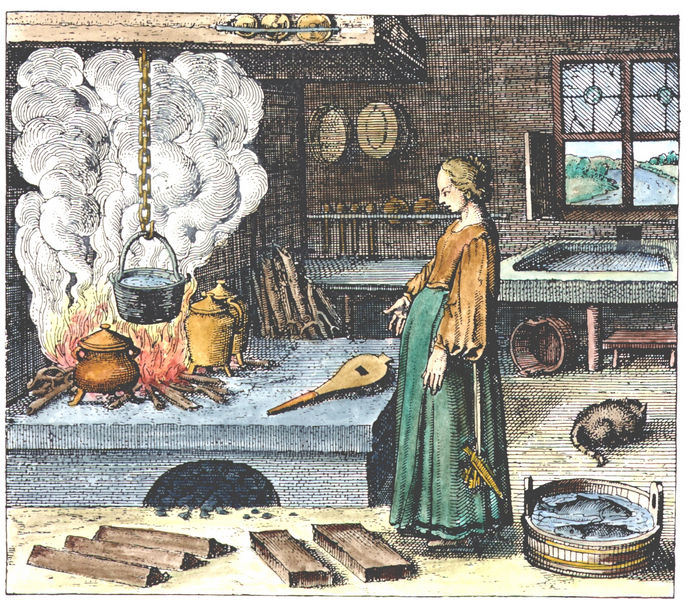
Michael Maier, Atalanta Fugiens: Emblemata Nova de Secretis Naturae Chymica, 1618. © Adam McLean 1997-2017 (alchemywebsite.com). Used with permission.
However, this is only one small part of banking “alchemy” thievery.
The hidden truth is that the banking high priest is not just a lying, cheating, fake “intermediary” officiating at the Sacred Marriage of Savers and Borrowers.
He is the infamous Mercury–Hermes (☿), the “purse”-sucking androgyne himself.
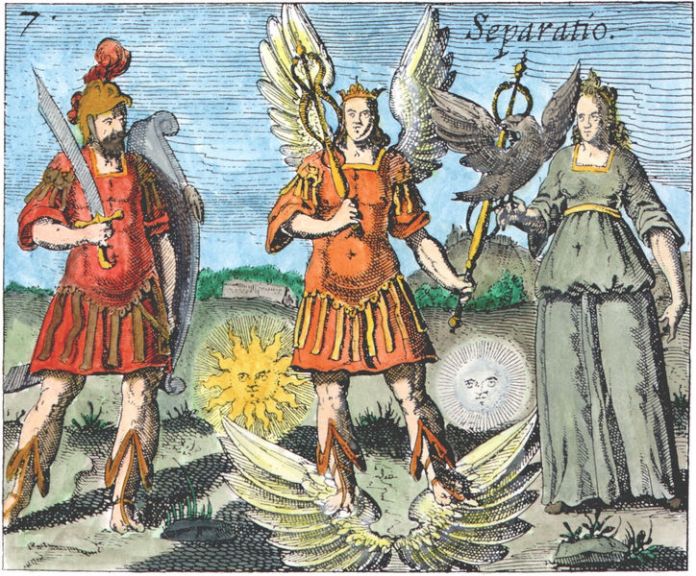
J.D. Mylius, Philosophia Reformata, 1622. © Adam McLean 1997-2017 (alchemywebsite.com). Used with permission.
Hiding behind economic babel (“confusion”) – and that owing much to the Paradox of Opposite Perspectives in double entry – the cheating time lord does not just shuffle promises to pay; he also creates new promises to pay.
False promises. Misleading promises. Deceptive promises.
“Fraudulent” promises – his promises – that he calls “credit” but is actually debt.
His debt.
He actually owes all of “our” debt … to us!
As Professor Werner has proven, that is how all “money of account” appears – and disappears – in the first place.
“The dragon slays itself, weds itself, impregnates itself.”[41]
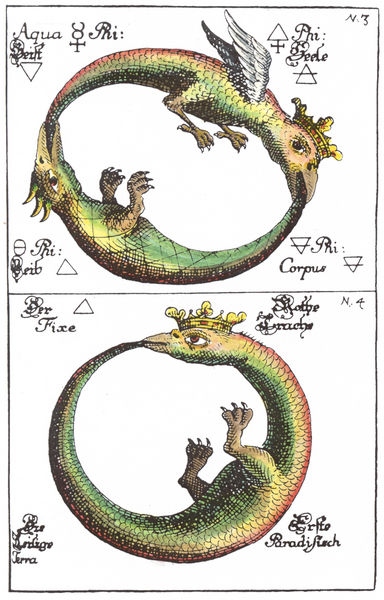
Samuelis Baruch, des Juden Rabbi, Astrologi und Philosophi, gebohren aus dem Stamm Abrahams, Isaacs, Jacobs und Judä, welcher erlernet das grosse Geheimniss des grossen Meisters Tubalkains aus dessen Tabell, gefunden von Abrahamo Eliazare, dem Juden. © Adam McLean 1997-2017 (alchemywebsite.com). Used with permission.
“The serpent devouring its own tail represents alternately
.. tempter and Redeemer.”[42]
Why do we “females” do this?
Why have we allowed these lying cheating “time gods” incarnate to keep returning to steal our gynergy, for over 5000 years?
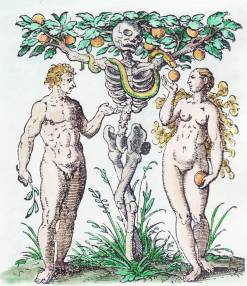
Woodcut by Jost Amman from Jacob Rueff, De conceptu et generatione hominis, Frankfurt, 1587. © Adam McLean 1997-2017 (alchemywebsite.com). Used with permission.
Temptation.
An offer.
A “trade”.
A devil’s pact.
A promise, of Yesh for Ayin.
Something for Nothing.
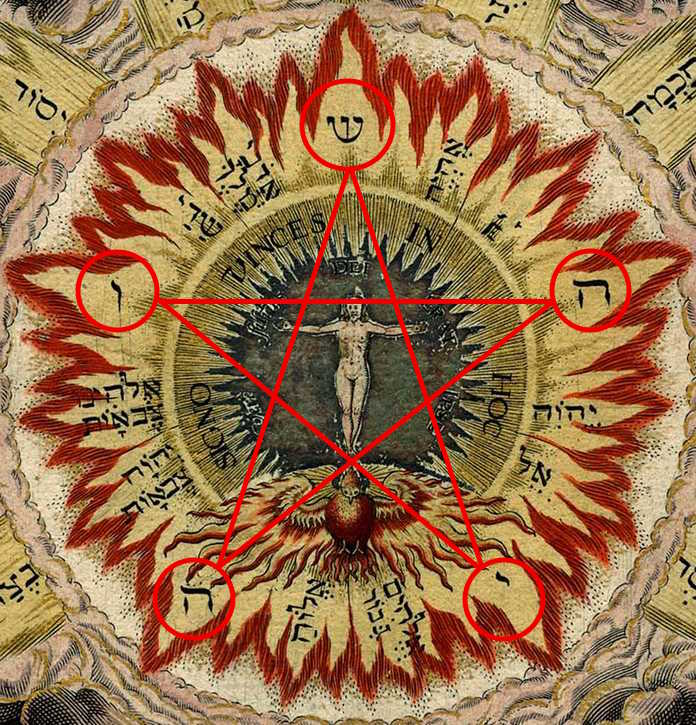
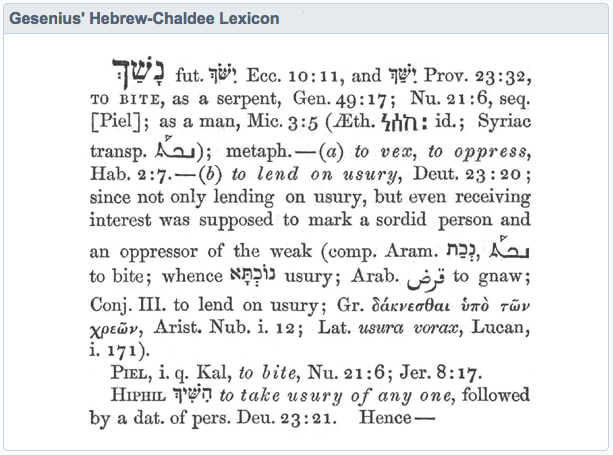
In a word – usury.
The cheating time lord sucks in the female’s “interest”, using a honey-sweet promise to pay her “interest”.
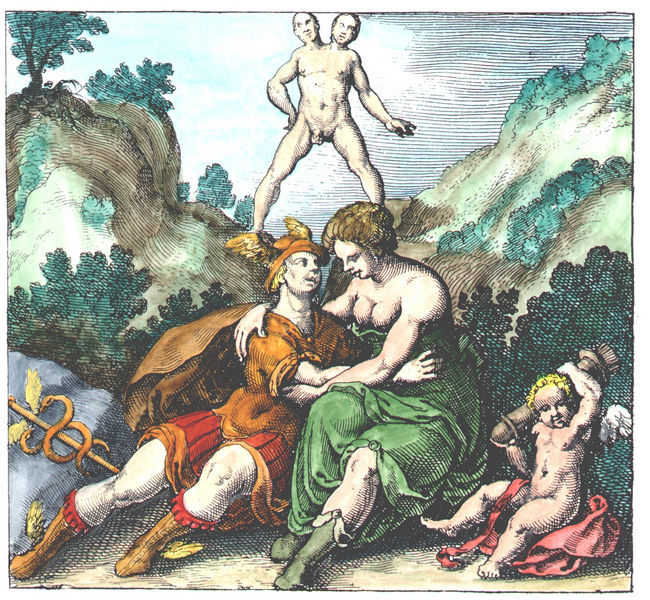
Michael Maier, Atalanta Fugiens, Emblemata Nova De Secretis Naturae Chymica, 1618. © Adam McLean 1997-2017 (alchemywebsite.com). Used with permission.
But only on the condition that she walks down the aisle, ties the knot … and lets him have her “deposit”.
Preferably, for a “locked in” “period”.
The longer the “term” until “maturity”, the more “interest” he promises to pay her.
She can only “redeem” her “deposit” – and the promised “yield” – when her “deposit” in his mystic temple has gone “full term”.
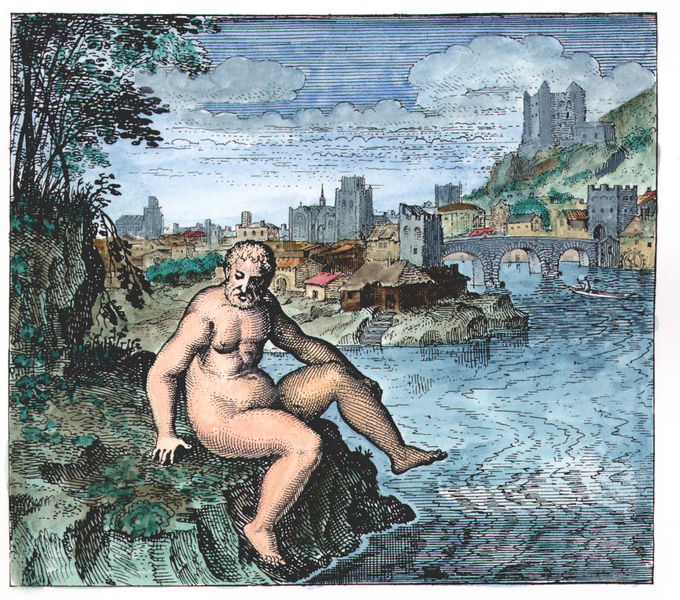
Michael Maier, Atalanta Fugiens: Emblemata Nova de Secretis Naturae Chymica, 1618. © Adam McLean 1997-2017 (alchemywebsite.com). Used with permission.
Thanks to the magic “$”, “€”, “£”, “¥”, and especially the “%” signs that he flashes in our eyes, we “females” are blinded to the reality.
His fake system is an inversion – a reversal – of “Mother” nature.
His system of promises is all about cheating, stealing, manipulating, dominating, and destroying the “autonomous existence” of the fundamental feminine principle – our mother nature.
Almost 2,500 years ago, Greek philosopher Aristotle pointed out that money is sterile. It does not naturally breed more money, the way that cows breed more cows. He explained that “Money exists not by nature but by law”:
The most hated sort [of wealth getting] and with the greatest reason, is usury, which makes a gain out of money itself and not from the natural object of it. For money was intended to be used in exchange but not to increase at interest. And this term interest (tokos), which means the birth of money from money, is applied to the breeding of money because the offspring resembles the parent. Wherefore of all modes of getting wealth, this is the most unnatural. (1258b, POLITICS)
For over 1000 years in the “Dark” and Middle Ages – when there was no separation of two “opposites”, the Church and the State – there was an official ban on the practice of usury.
Honoured sometimes as much in the breach as in the observance. There’s a long story of willfully-blind eyes there, all in itself.
But prohibition, nonetheless.
The defenders of usury prohibition were – are – precisely right.
Far more right, than any are given credit for.
The lying cheating system of false promises and fake “deposits”, of usury by double entry – the Royal Art of “the philosophers” – is contra naturam:
[Watch to the end. The devil’s in all the little details.]
*****************
END OF PART I
*****************
POSTSCRIPT
I hope that you have found Part 1 of this essay to be informative. Despite its length, it is only a barely adequate quick summary of the voluminous, multi-disciplinary literature touching the subject matter. To do the themes justice may well require a multi-volume book series. Publisher inquiries welcome.
My thanks to Professor Steve Keen and Professor Richard Werner for inspiration, support and economic reading suggestions, and kind assistance with accessing academic journals; to Dr. Omar Zaid for reading suggestions and support; to Adam McLean (alchemywebsite.com) for kindly granting permission to use his coloured alchemical images; to my family for love, patience and support; and to Anna Novikova for love, inspiration, support … and more reading suggestions! Finally, I would like to borrow a leaf out of the book of one wiser than I, in giving thanks for any good to be found here to the original source of all true wisdom (Jeremiah 33:3).
The interpretations and opinions expressed here are entirely mine – ergo, the aforementioned persons are not to be held in any way responsible for them, or for any errors or omissions.
Heav’n has no Rage, like Love to Hatred turn’d,
Nor Hell a Fury, like a Woman scorn’d.
In writing this essay, I earnestly hope to provoke in womenfolk the Fury of the Woman scorn’d.
I say this to all but especially to the menfolk reading: There is no way – in my opinion – that the Babylonian “Money Power” can ever be defeated, unless the tremendous power of the “scorn’d Woman” – and her fiercely-protective Mother nature – is invoked by all of us, and turned against her violator:
“Tell the housewife at her kitchen table about this stuff. She is smart. She understands. But if you keep it a secret, naturally she’s not going to be able to act, and we can’t transform something until we understand it.”
– Ann Pettifor, Money for Nothing
In Part 2 we will consider a perfect example of the righteous anger of the Woman scorn’d, from Old Babylonian mythology.
“Now whether the yogis can actually and permanently maintain control over the women through their ‘tricks’ (upaya) is another question. This is solely dependent upon their magical abilities, over which we do not wish to pass judgement here. The texts do repeatedly warn of the great danger of their experiments. There is the ever-present possibility that the ‘daughters of Mara’ see through the tricky system and plunge the lamas into hell.”
Robert H. Bork (The Antitrust Paradox) wrote that “One of the uses of history is to free us of a falsely imagined past. The less we know of how ideas actually took root and grew, the more apt we are to accept them unquestioningly, as inevitable features of the world in which we move.”
In Part 2, we will travel back to ancient Mesopotamia, and trace forward from the earliest recorded, pre-writing origins of the two fundamental principles that lie at the heart of the Babylonian “money of account” usury system.
We will learn more – and more repulsive – details about alchemical sex magic “experiments” and rituals. We will also consider the Old Babylonian magico-religious objects and incantations (“spells”), and learn the real significance of the winged lions guarding the city of Venice, and the City of London financial district.
We will also discover the “explosive” and enlightening ingredients in the Old Babylonian secret alchemical recipe for making fake silver counterfeits of the royal standard ingots.
Thank you for reading, and sharing.
**********
“Doublethink means the power of holding two contradictory beliefs in one’s mind simultaneously, and accepting both of them. (…) Doublethink lies at the very heart of Ingsoc, since the essential act of the Party is to use conscious deception while retaining the firmness of purpose that goes with complete honesty. (…) It need hardly be said that the subtlest practitioners of doublethink are those who invented doublethink and know that it is a vast system of mental cheating.”
– George Orwell, 1984
**********
FOOTNOTES
[1] Daniel Gross, The End of the BSD, Slate, Sept 25, 2008 — “(Relevant quote: ‘If he could make millions of dollars come out of those phones, he became that most revered of all species: a Big Swinging Dick.’)”
[2] Miroslav Novák, Heritage of Alchemical Cryptography (2013), Il Chimico Italiano 24: 17-24 — “Medieval European alchemists used a disorganized way of coded expressing together with a very complicated system of diverse graphical symbols... The symbols, besides their shorthand role, also serve as a specific cryptographic system, for very often the alchemists tried to conceal the results from the Christian church, avaricious noblemen and possible competitors. [..] The cryptography (or cryptology; from Greek κρυπτός, “hidden, secret”; and γράφειν, “writing”, or λογία, “study”, respectively) is the practice and study of techniques for secure communication in the presence of third parties (called adversaries) (Wikipedia). And these adversaries were the main reason, why alchemists coded their written products.”
[3] Samuel Scarborough, The Imagery of Alchemical Art as a Method of Communication, Journal of the Western Mystery Tradition No. 9, Vol. 1, Autumnal Equinox (2005) — “[T]he metalworkers, especially the gold and silver smiths, who in the Middle Ages and early Renaissance formed guilds to protect their secrets and craft worked with a kind of alchemy that was later to become metallurgy.”
“Alchemists, like modern day scientists, would share their findings and works with one another [..] So, how could alchemists from various countries and parts of Europe communicate in a safe manner without giving away their secrets? The answers came as allegory and allegorical imagery, which hid, from the uninitiated what was being discussed and shared amongst them.”
“This form of discussion or conveying information and ideas in allegorical images would later go on to influence several bodies of dramatic initiating orders or lodges. Among these would be the Freemasons, the Rosicrucians, particularly the fringe Masonic bodies, and even the magickal orders of the nineteenth century. This idea that images convey a message and power is powerfully illustrated in a line from the Neophyte Initiation Ceremony: ‘…for by Names and Images are all Powers awakened and re-awakened.'”
[4] V. and V. Trimondi, The Shadow of the Dalai Lama: Sexuality, Magic and Politics in Tibetan Buddhism (2003), transl. by Mark Penny; p.77 — “In order to keep hidden from the public all the offensive things which are implicated by the required breaches of taboo, some tantra texts make use of a so-called ‘twilight language’ (samdhya-bhasa). This has the function of veiling references to taboo substances, private bodily parts, and illegal deeds in poetic words, so that they cannot be recognized by the uninitiated. For example, one says ‘lotus’ and means ‘vagina’, or employs the term ‘enlightenment consciousness’ (bodhicitta) for sperm, or the word ‘sun’ (surya) for menstrual blood. Such a list of synonyms can be extended indefinitely.”
[5] ibid., p. 102; — “Just as in some tantra texts, ‘secret’ practices were represented by ‘harmless’ images in the European treatises; this was especially true of the topic of erotic love and sexuality.”
“Both the tantric and the alchemic writings are [..] maps of the erotic imagination and anyone with a little speech psychology can recognize the pervasive sexual system of reference hidden in a hermetical text from the 16th century. At that time people did not have the slightest qualms about describing chemical processes as erotic events and erotic scenarios as chemical fusions. They behaved in exactly the same manner in the West as in the East.”
[6] Martin Wolf, Will there be another huge financial crisis?, Irish Times, June 1 2016
[7] I have chosen not to specify here the artisanal guild in question, in view of intention to publish a book encompassing the subject.
[8] Hieros gamos, Encyclopædia Britannica — (Greek: “sacred marriage”), sexual relations of fertility deities in myths and rituals, characteristic of societies based on cereal agriculture, especially in the Middle East. At least once a year, divine persons (e.g., humans representing the deities) engage in sexual intercourse, which guarantees the fertility of the land, the prosperity of the community, and the continuation of the cosmos.
Some scholars have applied the term hieros gamos to all myths of a divine pair (e.g., heaven–earth) whose sexual intercourse is creative. The term, however, should probably be restricted only to those agricultural cultures that ritually reenact the marriage and that relate the marriage to agriculture, as in Mesopotamia, Phoenicia, Canaan, Israel (the Song of Solomon has been suggested to be a hierogamitic text), Greece, and India.
[9] V. and V. Trimondi, The Shadow of the Dalai Lama: Sexuality, Magic and Politics in Tibetan Buddhism (2003), transl. by Mark Penny; pp. 40, 585 — “..if we translate upaya (as it is clearly intended) as ‘cunning means’ or even ‘trick’ or ‘ruse’ (Wilber, 1987, p. 310).”
upaya – “‘skill in means’ – array of expedient devices employed by bodhisattvas to enlighten beings trapped in suffering existence.”
“To summarize, upaya stands for the masculine principle, the phallus, motion, activity, the god, enlightenment, and so forth; prajna represents the feminine principle, the vagina, calm, passivity, the goddess, the cosmic law. All women naturally count as prajna, all men as upaya.” (p.39)
[10] Silent Weapons for Quiet Wars; The Lawful Path (1996), citing William Cooper, Behold A Pale Horse (1991), Light Technology Publishing
[11] V. and V. Trimondi, The Shadow of the Dalai Lama: Sexuality, Magic and Politics in Tibetan Buddhism (2003), transl. by Mark Penny; p. 47, 65, 93; — “Modern Western authors with views compatible to those of Buddhism [..] tend toward the opinion that the tantric androgyne harmonizes both sexual roles equally within itself, so that the androgynous pattern is valid for both men and women. But this is not the case. Even at an etymological level, androgyny (from Ancient Greek anér ‘man’ and gyné ‘woman’) cannot be applied to both sexes. The term denotes [..] the male-feminine forces possessed by a man, whilst for a woman the respective phenomenon would have to be termed ‘gynandry’ (female-masculine forces possessed by a woman).”
“The tantric yogi unites with her not just in the sexual act, but above all through consuming her holy gynergy, the magical force of maya. Sometimes, as we shall see, he therefore drinks his partner’s menstrual blood. Only when the feminine blood also pulses in his own veins will he be complete, an androgyne, a lord of both sexes.”
“In the usual yab–yum representation of the Dhyani Buddhas, the male Buddha figure always crosses both of his arms behind the back of his wisdom consort, forming what is known as the Vajrahumkara gesture. At the same time he holds a vajra (the supreme symbol of masculinity) in his right hand, and a gantha (the supreme symbol of femininity) in his left. The symbolic possession of both ritual objects identifies him as the lord of both sexes. He is the androgyne and the prajna is a part of his self.”
[12] Mahmoud Ezzamel and Keith Hoskin, Retheorizing Accounting, Writing and Money with Evidence from Mesopotamia and Ancient Egypt, Critical Perspectives on Accounting (2002) 13, 333–367; — “The distinctive development that we see introduced by the invention of money of account is a principle of value reciprocity. Money of account constructs value by denominating it as something other than, and separate from, either the commodity or its accounting; instead value becomes something which passes reciprocally between the two, supposedly guaranteeing that each is equalised in value terms. In so doing, the role of money as supplementer of value is concealed behind an apparent but deceptive power to guarantee equivalence. Moreover, the power of money enables the construction of previously unprecedented levels of wealth, and the possibility of new power relations for those with money and those without it.”
“[M]oney plays a double game. First, it appears as the benign supplement, embodying the new possibility that value exists in a separate denominable form and simply making space for itself as numeraire to act as the measure of that value. But secondly, money is also the dangerous supplement. Beneath the apparent surface where equivalence reigns and money is just a transparent medium, the play of difference is at work: from the production of little remainders and marginal inequalities, through the generation of interest and profit, to money’s own re-writing into new and more complex instruments.”
[13] Vladimír Karpenko, Alchemy as donum dei, HYLE – International Journal for Philosophy of Chemistry, Vol. 4 (1998), No. 1, pp. 63-80; — “In the Tenth Discourse of his treatise Al-Fihrist,[12] An-Nadim (A.D. 987) writes, after the introductory basmallah, about the origin of alchemy [§ 1]: ‘The adepts of the Art of Alchemy, … assert that the science of the Art was first discussed by Hermes, the Sage, the Babylonian …’.”
[14] Antoine Faivre, The Eternal Hermes: From Greek God to Alchemical Magus (1995), pp. 36-38; — “Panurge is not only connected to the tradition of Hermetic magic: he also has something of the humanist Hermes, the savant of his time. This does not prevent him from being at the same time a sort of alchemist, for he claims to possess the Philosophers’ Stone: ‘I have a philosophical stone which sucks money out of purses as the magnet attracts iron.’ And in his speech in praise of debtors, he speaks of the ‘joy of the alchemists when, after long labors, great care and expense, they see the metals transmuted in their furnaces.'”
[15] V. and V. Trimondi, The Shadow of the Dalai Lama: Sexuality, Magic and Politics in Tibetan Buddhism (2003), transl. by Mark Penny; pp. 121-122 — “Even if many tantric texts speak only of bodhicitta, the male seed, at heart it is a matter of the absorption of both fluids, the male and the female, in short — of sukra. Admittedly the mixing of the sexual fluids does seem incompatible with the prohibition against ejaculation, but through the so-called Vajroli method the damaging consequences of the emission of semen can be reversed..”
“The bodhicitta is also called bindu, which means ‘point’, ‘nil’, ‘zero’, or ‘drop’.” (p. 135)
[16] ibid., p. 124 — “The initiation path of the Kalachakra Tantra [..] now leads us on to the four highest initiations, or rather to the twelfth to fifteenth initiation stages. [..] The reader will soon see that we are dealing with an extended copy of the four ‘higher initiations’ (8–11). They thus also bear the same names: (12) the vase initiation; (13) the secret initiation; (14) the wisdom initiation; and (15) the word initiation. The difference primarily consists in the fact that rather than just one mudra, ten wisdom consorts now participate in the ritual. All ten must be offered to the master by the pupil (Naropa, 1994, p. 193). There are different rules for monks and laity in this regard. It is required of a layman that the mudras be members of his own family — his mother, his sister, his daughter, his sister-in-law, and so on (Naropa, 1994, p. 192). This makes it de facto impossible for him to receive the Kalachakra solemnity. Although the same commandment applies to a monk, it is interpreted symbolically in his case. Hence, he has to deliver to his guru numerous girls from the lower castes, who then adopt the names and roles of the various female relatives during the ritual. Among other things the elements are assigned to them: the ‘mother’ is earth, the ‘sister’ water, the ‘daughter’ fire, the ‘sister’s daughter’ is the wind, and so on (Grünwedel, Kalacakra III, p. 125). After the pupil has handed the women over to his master, he is given back one of them as a symbolic ‘spouse’ for the impending rites (Naropa, 1994, p. 193).”
[17] ibid., p. 122-123 — “Here can be seen very clearly how much of a calculating and technical meaning the term upaya (method) has in the tantras.”
“Equivalent quotations from many other Western interpreters of Tantrism can be found: ‘In … Tantrism … woman is means, an alien object, without possibility of mutuality or real communication’ (quoted by Shaw, 1994, p. 7). The woman ‘is to be used as a ritual object and then cast aside’ (also quoted by Shaw, 1994, p. 7). Or, at another point: the yogis had ‘sex without sensuality … There is no relationship of intimacy with an individual — the woman … involved is an object, a representation of power … women are merely spiritual batteries‘ (quoted by Shaw, 1994, n. 128, pp. 254–255). The woman functions as a ‘salvation tool’, as an ‘aid on the path to enlightenment’. The goal of Vajrayana is even ‘to destroy the female’ (quoted by Shaw, 1994, p. 7).” (p. 47)
[18] ibid., p. 122; citing Eliade, 1985, p. 257, Shaw, 1994, p. 157, and White, 1996, p.200
[19] ibid., p. 122, citing Shaw, 1994, p. 158.
[21] ibid., p. 60, 62 — “[A]lthough her autonomous feminine existence has been dissolved, her feminine essence (gynergy) has not been lost. Via an act of sexual magic the yogi has appropriated this and with it achieved the power of an androgyne. He destroys, so to speak, the exterior feminine in order to internalize it and produce an ‘inner woman’ as a part of himself. ‘He absorbs the Mother of the Universe into himself’, as it is described in the Kalachakra Tantra (Grünwedel, Kalac[h]akra IV, p. 32).”
“In general, the maha mudra is said to reside in the region of the navel. There she dances and acts as an oracle as the Greek goddess Metis once did in the belly of Zeus. [..] The male tantric master now has the power to assume the female form of the goddess (who is of course an aspect of his own mystical body), that is, he can appear in the figure of a woman. Indeed, he even has the magical ability to divide himself into two gendered beings, a female and a male deity. He is further able to multiply himself into several maha mudras.”
[22] ibid., p. 48 — “In place of the human ego is the superego of a god with far-reaching powers. This superhuman subject knows no bounds when it proclaims in the Hevajra Tantra, ‘I am the revealer, I am the revealed doctrine and I am the disciple endowed with good qualities. I am the goal, I am the master of the world and I am the world as well as the worldly things” (Farrow and Menon, 1992, p. 167).'”
[23] ibid., pp. 77; 102-103 — “[F]or the ‘true’ adept (whether Tantric or European alchemist) it was not just a matter of the actual yellow metal, but also the so-called ‘spiritual gold’. In the West this was understood to mean the ‘Philosopher’s Stone’ or the ‘hermetical elixir’, which transformed the experimenter into a superman. Alchemy and Tantrism thus have the same spiritual goal. In order to achieve this, numerous processes of conversion were needed in the laboratory of the adept, which did not just take the form of chemical processes, but which the alchemist also experienced as successive transmutations of his personality, that is, his psyche was dissolved and then put together again a number of times in the course of the experimentation. Solve et coagula (dissolve and bind) is for this reason the first and most well-known maxim of the hermetical art.”
[24] David Astle, The Babylonian Woe (1975), pp. 15-16, citing G.R. Driver and John C. Miles, Ancient Codes and Laws of the Near East (Clarendon Press, Oxford); and Professor W.F. Albright, The Amarna Letters from Palestine (Cambridge University Press)
[25] Miroslav Novák, Heritage of Alchemical Cryptography (2013), Il Chimico Italiano 24: 17-24
[26] Elizabeth Loupas, Alchemy and a ducal mistress: One prince’s deadly obsessions (2014).
[27] Bibliotheca Chemica, p. 453; D.S.B.; cited by Abe Books, Item Description: 1571. THURNEISSER ZUM THURN, Leonhart. PROKATALEPSIS ODER PRAEOCCUPATION, DURCH ZWOLFF VERSCHEIDENLICHER TRACTATEN; GEMACHTER HARM PROBEN. Frankfurt: Johann Eichorn, 1571. First edition. (24 June 2017)
[28] Richard A. Werner, To a new understanding of the function of the banking sector: the mechanism of productive credit creation and quantitative easing; presentation to the Russian Academy of Sciences, round table “Anti-crisis fiscal policy of the state in the interests of economic development of Russia” (2015). (watch video)
[29] John Pollack, The Pun Also Rises: How The Humble Pun Revolutionized Language, Changed History, And Made Wordplay (2011), cited in Wikipedia: Pun (21 June 2017)
[30] Richard A. Werner, How do banks create money, and why can other firms not do the same? An explanation for the coexistence of lending and deposit-taking (2014) — “What banks do is to simply reclassify their accounts payable items arising from the act of lending as ‘customer deposits’, and the general public, when receiving payment in the form of a transfer of bank deposits, believes that a form of money had been paid into the bank. As a result, the public readily accepts such ‘bank deposits’ and their ‘transfers’ to defray payments. They are also the main component of the official ‘money supply’ as announced by central banks (M1, M2, M3, M4), which is created almost entirely through this act of re-classifying banks’ accounts payable as fictitious ‘customer deposits’.”
[31] V. and V. Trimondi, The Shadow of the Dalai Lama: Sexuality, Magic and Politics in Tibetan Buddhism (2003), transl. by Mark Penny, p.104
[32] Andy Haldane, Trust and Finance, Institute for New Economic Thinking, Oct 2013
[33] V. and V. Trimondi, The Shadow of the Dalai Lama: Sexuality, Magic and Politics in Tibetan Buddhism (2003), transl. by Mark Penny; pp. 119, citing White, 1996, p. 28
[34] ibid., p. 123 — “‘If the woman is too powerful or too old or too young, terrible things will happen to the innocent man who falls into her trap, a fact often depicted in terms of his losing his fluids’ (O’Flaherty, 1982/1988, p. 56).”
“Now whether the yogis can actually and permanently maintain control over the women through their ‘tricks’ (upaya) is another question. This is solely dependent upon their magical abilities, over which we do not wish to pass judgement here. The texts do repeatedly warn of the great danger of their experiments. There is the ever-present possibility that the ‘daughters of Mara’ see through the tricky system and plunge the lamas into hell.” (p. 268)
[35] ibid., p. 123 — “Is this purely a matter of male fantasies? Not at all — a gynocentric correspondence to the thieving seed-absorption is, namely, known from the Kali cults to be a ritual event. Here, the woman assumes the upper position [in] the sex act and in certain rites leaves the man whose life energies she has drained behind as a corpse. According to statements by the Tibet researcher, Matthias Hermanns¸ there were yoginis (female yogis) who received instruction in a technique ‘through which they were able to forcibly draw their partners’ semen from out of the penis’, and the author concludes from this that, ‘It is thus the counterpart of the procedure which the yogi employs to soak up the genital juices of several women one after another through his member’ (Hermanns, 1965, p. 19).”
[36] ibid., pp. 118-119 — “[T]he tantras teach that the semen is originally stored in a moonlike bowl beneath the roof of the skull. As soon as a person begins to experience sexual desire, it starts to flow out, drop by drop, passing through the five energy centers (chakras). In each of these the yogi experiences a specific ‘seminal’ ecstasy (Naropa, 1994, p. 191). The destination of the sperm’s journey within the body is the tip of the penis. Here, through extreme meditative concentration, the adept collects the lust: ‘The vajra [penis] is inserted into the lotus [vagina], but not moved. When lust of a transient art arises, the mantra hum should be spoken. … The decisive [factor] is thus the retention of the sperm. Through this, the act obtains a cosmological dimension. … It becomes the means of attaining enlightenment (bodhi)” (Grönbold, Asiatische Studien, p. 34). ‘Delight resides in the tip of the vajra [penis]’, as is said in a Kalachakra text (Grönbold, 1992a)…”
[38] Richard A. Werner, How do banks create money, and why can other firms not do the same? An explanation for the coexistence of lending and deposit-taking (2014) — “The act of signing the loan contract and purchasing it as a promissory note of the borrower without yet making the borrowed funds available to the borrower (Step 1) has the same accounting implications for banks, non-banks and non-financial corporations alike. In all cases, the balance sheets lengthen, as an asset (the loan contract) is acquired and a liability to make money available to the borrower is incurred (accounts payable).”
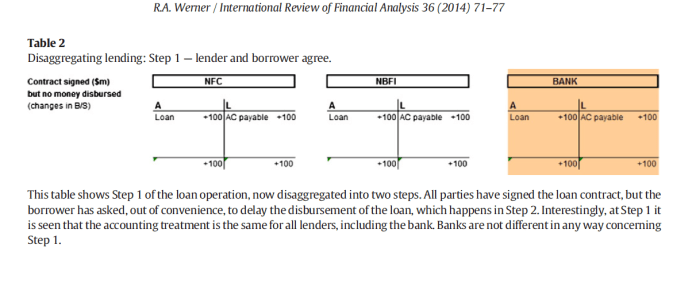
“In Step 2, the lender makes the funds available to the borrower. The fact that in Step 2 the bank is alone among firms in showing the same total impact on assets and liabilities as everyone else at Step 1, when the money had not yet been made available to the borrower, demonstrates that the bank did not actually make any money available to the borrower. This means that the bank still has an open ‘accounts payable’ liability, as it has not in fact discharged its original liability.”
“For banks only the balance sheet remains unchanged in its EXPANDED position .. In other words: banks do not discharge their liability.”
[39] V. and V. Trimondi, The Shadow of the Dalai Lama: Sexuality, Magic and Politics in Tibetan Buddhism (2003), transl. by Mark Penny, p. 119, citing Grönbold, Asiatische Studien, p. 34.
[40] Stephen D. Simpson, The Banking System: Commercial Banking – Economic Concepts in Banking, Investopedia (1 July 2017)
[41] Zosimos Alchemista of Panopolis, Tractatus Avicennae, Alchemist Wikia, (1 July 2017)
[42] Éliphas Lévi, Dogme et Rituel de la Haute Magie, 1855; (Transcendental Magic: Its Doctrine and Ritual, translated by A.E. Waite (1896), p. 80-81












 PSALMISTICE