General

Learning to fly

Presently, I am reading two tomes. Both new to me. The which, on any particular day, depends on what I feel is most in need.

If balm for the heart, Theologia Germanica.

If manna for the mind, Symbols of Sacred Science.

I have been vividly reminded of a poem that I wrote some four years ago. Its inspiration arose out of care for a friend, who had declared that their choices in life were determined by a single criterion.

To follow the passions.

Thanks to the authors of my present reading, I am humbly coming to see that this, my first attempt at poetry, bespeaks an infinitely greater — profundity — than I had realised originally.


Returning

On edge of home I looked beyond,
And felt the winds of Passion strong,
Spread my wings to heed the call,
I did not know how to fly at all.

Watched mother and father timorously,
Examples to show me how it should be,
I never knew while in their thrall,
They did not know how to fly at all.

When blew no winds of Passion fair,
I spread my wings and beat the air,
Created feelings, passions small,
Still I knew not how to fly at all.

My wings grew strong, desires too,
For things beyond the things I knew,
Pleasures waiting on yonder shore,
But I knew not how to fly at all.

Growing restless to leave home,
Family near, yet on my own,
And though the nest began to pall,
I did not know how to fly at all.

On frantic wings one day, ascent!
A little rise brought confidence,
Self-made feelings of power, control,
Still I knew not how to fly at all.

When Passion said to say goodbye,
To spread my fledgling wings and fly,
I left the nest with rending squall,
Still knowing not how to fly at all.

O what adventure! Look out below!
Here I come on Passion’s flow,
Gliding on high, though ever in fall,
For I knew not how to fly at all.

Soon I discovered what power is mine,
Wings filled with Passion can surely rise,
Yet this power was without control,
I did not know how to fly at all.

Passion and Reason, Conscience and Will,
Balance of forces I needed still,
Impassioned wings can rise and fall,
I did not know how to fly at all.

On force of Will I first took flight,
Beating the air with all my might,
Thought in my wings true Passion hold,
But I knew not how to fly at all.

With youthful vigour, strength of heart,
Flailing wings the beginner’s art,
Flights of fancy, Self-effort called,
I did not know how to fly at all.

Rising boldly, fading fast,
Self-Willed passions do not last,
And so my wings would finally stall,
I did not know how to fly at all.

Exhausted, grounded, my limits shown,
Yearning for place of rest called ‘Home’,
Strength of Will now broken, for
I did not know how to fly at all.

Selfish Will a mysterious thing,
Though humbled briefly, up it springs,
Trapped in this cycle of rise then fall,
I did not know how to fly at all.

Eventually I, too tired to fight,
Eyes freed from Self, received insight,
Of Passion to replace my toil,
When I had no strength to fly at all.

I saw again the wind that blows,
From source not me, but heaven knows,
My childhood days that wind recalled,
When I knew not how to fly at all.

And so I learned an easier way,
To wait and watch for trees to sway,
Then glide away on Passion’s call,
Still I knew not how to fly at all.

Force of Passion, not of mine,
No need of beating wings to fly,
Force of Will not needed more,
Still I knew not how to fly at all.

For winds to their direction be,
So how could I be truly free?
Power of Passion, without control,
I did not know how to fly at all.

Swept along by Passion one day,
I Willed to go a different way,
Turned by force of Reason sure,
Still I knew not how to fly at all.

Reason comes after Passion you see,
As eagle’s tail rests in the lee,
As rudder steers from aft the fore,
But I did not know how to fly at all.

O what joy! How I adored,
This power to go with Passion, or
To go where Reason should implore,
Still I knew not how to fly at all.

Force of Reason, for good or ill,
Wings filled with Passion, turned at Will,
Feelings of power and control,
I did not know that I have none at all.

Though at last some balance found,
Passion held to Reason’s sound,
Choice of direction at Will’s call,
Still I knew not how to fly at all.

For winds blow flush, not up and down,
So how to rise up from the ground?
How to transcend these Passions’ thrall?
I did not know how to fly at all.

So I studied the way of flight,
By force of Reason’s pilot light,
These unseen forces I explored,
When I knew not how to fly at all.

Wind over wing, it faster flows,
And there it forms a pressure Low,
While under wing a pressure High,
That lifts my wing into the sky.

So when I turned with wings inclined,
To face the winds of Passion, I
Brought Passion under, Self controlled,
Still I knew not how to fly at all.

The more my wings to heaven inclined,
The more I rose into the sky,
Until a point at which I stalled,
I did not know how to fly at all.

For Passion only goes so high,
Like wall of wind in bluest sky,
At unseen height there is no more,
So I could no longer rise at all.

And now what’s more I knew again,
With rising height, my oldest friend,
Selfish Will so natural,
I did not know how to fly at all.

With rising up a higher view,
A looking down on others who,
Shrank from my sight as Pride grew tall,
I did not know how to fly at all.

Passion sees no consequence,
Is prone to overconfidence,
Caught up in Pride of Passion’s thrall,
I did not know how to fly at all.

In time I learned sunrise to noon,
Tells of Passions warm, but soon,
Cooler winds as evening falls,
Still I knew not how to fly at all.

In summer Passion’s winds run hot,
And winter’s chill is soon forgot,
Then seasons change, warm feelings cold,
And I knew not how to fly at all.

For Passion’s heat will always fade,
Chill to the bone, and feelings jade,
Cold, exhausted, insecure,
I did not know how to fly at all.

Longed for warmth, looked for a mate,
Thinking to share a happy Fate,
Bonds of Passion I explored,
And found they do not fly at all.

For how can two together fly,
When in the spell of lovers’ guise,
Unbalanced forces are ignored,
And neither half can fly at all.

Two Selfish Passions bound will rise,
Until the weaker falls behind,
Or stronger leaves for different score,
And broken wings don’t fly at all.

That’s why they say we fall in love,
It’s not Love True they’re speaking of,
But Passions bound in Selfish thrall,
They do not know how to fly at all.

This is how for years I roamed,
Adrift on Passions, far from home,
False comfort said, “I’m in control”,
But I did not know how to fly at all.

Then I began to wonder why,
Mighty eagles soar so high,
While others near to earth endure,
I did not know how to fly at all.

And so I watched the eagles’ flight,
Turning ever inward, out of sight,
Serene departing earthly ball,
I did not know how they fly at all.

If winds do not blow up and down,
Then what lifts eagles from the ground?
What force or power rising tall?
I did not know how they fly at all.

Thermals rising I could not see,
Unlike the wind seen in the trees,
Force of Conscience my chief sensor,
God’s altimeter set inside us all.

Warm currents rise, cold currents fall,
Love to God in warmth enfolds,
Love to Self is comfort cold,
And can not really fly at all.

When Passion bound I Willed to be,
Love towards Heaven I could not see,
Only Conscience free from Selfish pall,
Can sense each moment’s rise or fall.

I began to practice turning in,
But there I found the weight of sin,
Heavy Conscience I’d ignored,
The reason I could not fly at all.

For every Selfish act it lays,
On Conscience a little debt to pay,
Passion blind to how it grows,
And weighs us down to earth below.

This, the heaviest weight to bear,
More of Self doomed to despair,
To be set free this chain and ball,
Less of Self comes first of all.

But where the power to set free,
When love of Self comes naturally?
Till death of Self, and God adored,
I did not know how to fly at all.

A humbled Self was necessary,
Before I could be truly free,
We’re flying on power of Self so-called,
If ever we should feel tired at all.

Humility needed, Patience too,
To rise up with wings as eagles do,
Strength renewed by power of Love,
In waiting on the Lord above.

The words of God, Isaiah’s creed,
“In returning and rest you shall be freed”,
Turn toward heaven, resting on Love,
Source of Strength to rise above.

Movement with rest”, the Master intoned,
To doubting Thomas and he alone,
“The Sign of the Father in your soul”,
Showing The Way to fly to all.

Pillar of cloud, day guide will be,
Pillar of fire, by night to see,
Spiralling up to the heavens tall,
Showing the Path of flight to all.

Turning left or turning right,
Matters not for upward flight,
Carried to heaven, looking to the All,
Only turning from Self will fly at all.

Serpent coiled around a tree,
Ancient symbol of healing be,
Of Resurrection, this foretold,
The only Way to fly at all.

DNA, twin helix of life,
Jacob’s Ladder, from earth to Light.
Turning, returning, spiralling tall,
A stairway to heaven inside us all.

Spiralling up to Heaven’s Gate,
This my Passion, Will, and Fate,
Death of Self, only God adored,
Now I Know how to fly with All.

© The Blissful Ignoramus – 2010

Standard
General

Remember to surrender

angel+wallpaper+for+desktop+5

Earlier this week, within the space of 24 hours, I had occasion to experience shaking with anger, and, shaking with grief.

Shortly after the shaking had subsided — a great sadness released — something dawned on me, just as I was packing my motorcycle to return home, and, just as the sun appeared, from behind a coldly cloudy afternoon.

Both experiences were all about energy. And resistance.

Or, viewed another way, both experiences were a consequence of error.

The error of holding on to energy. Resisting. Rather than letting all things flow.

Both the anger, and the grief, were a release of pent-up energy.

Energy that would not have pent up, if I had not impeded the flow.

How so?

Control.

Trying to insert “me” into this world.

Trying to influence. To correct. To shape. To steer.

To control.

This holding on, this grasping, this resistance, this seeking to control things, situations, outcomes, it was this action of “me” — natural, though it be — that held up, restricted, impeded, the flow.

Like the natural “me” resistance in a wire, impeding the flow of electrical energy.

Lesson learned.

To let it all go.

From the get-go.

To remember.

To surrender.

To chill.

Like a superconductor.

And just … watch … the flow.


Standard
General

Strange days indeed

Nobody told me there’d be days like these
Strange days indeed — most peculiar, mama

Was I reading, meditating, or praying at that moment? I can not say. I can not recall. At the time, it did not seem especially significant.

I heard it first before, and below me. A few hundred metres distant. The clear, sharp sound of a horse’s hooves. A horse well shod — the distinct sound, one can tell. First cantering, then trotting, cantering, then trotting again, on the road’s hard-packed stony clay.

The sound came loudly on the still mountain air. I could not help but have my awareness drawn to it, for a short while. The road below, invisible from my rocky perch, screened from view by the forest of trees.

CIMG2142

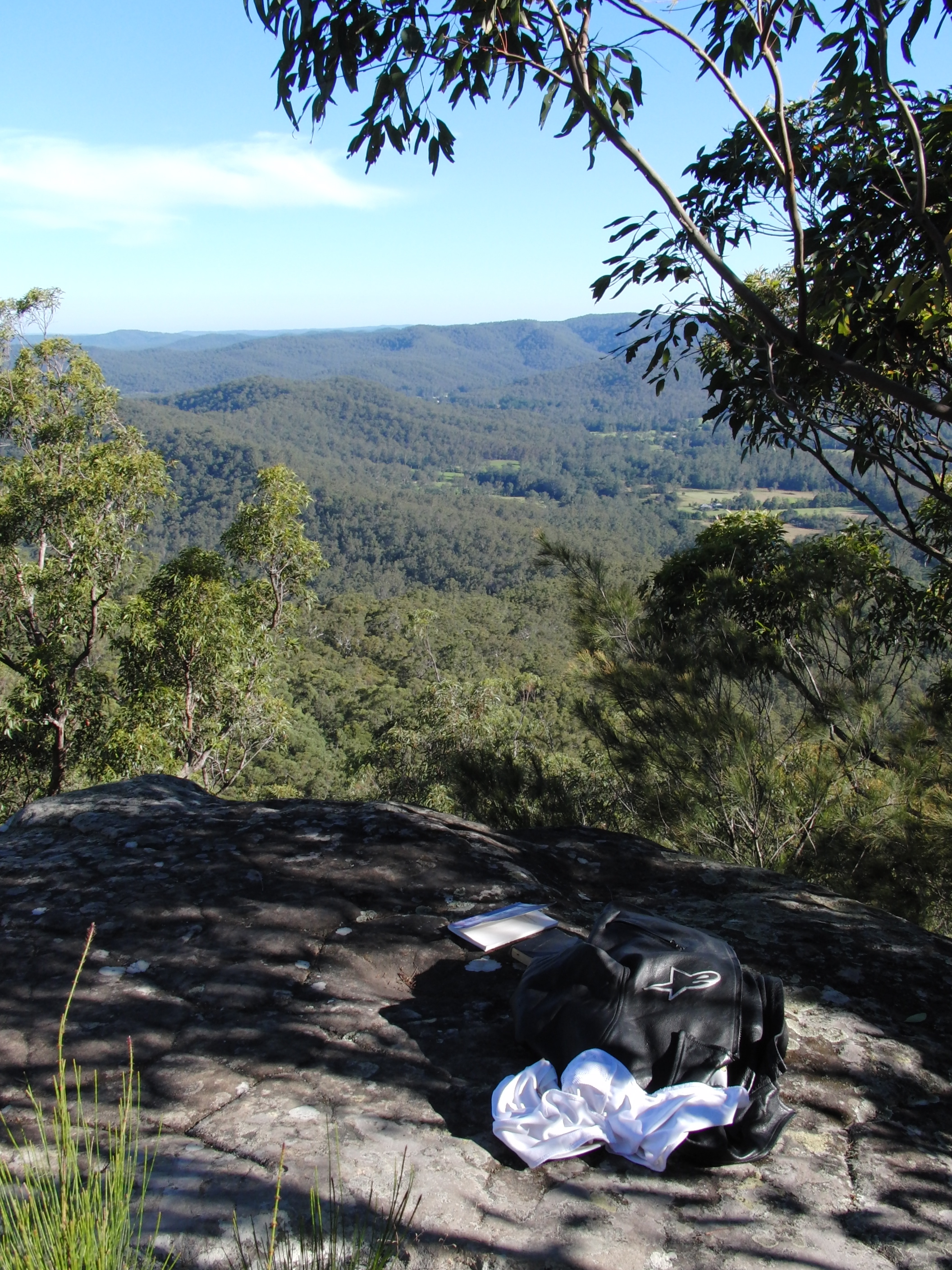
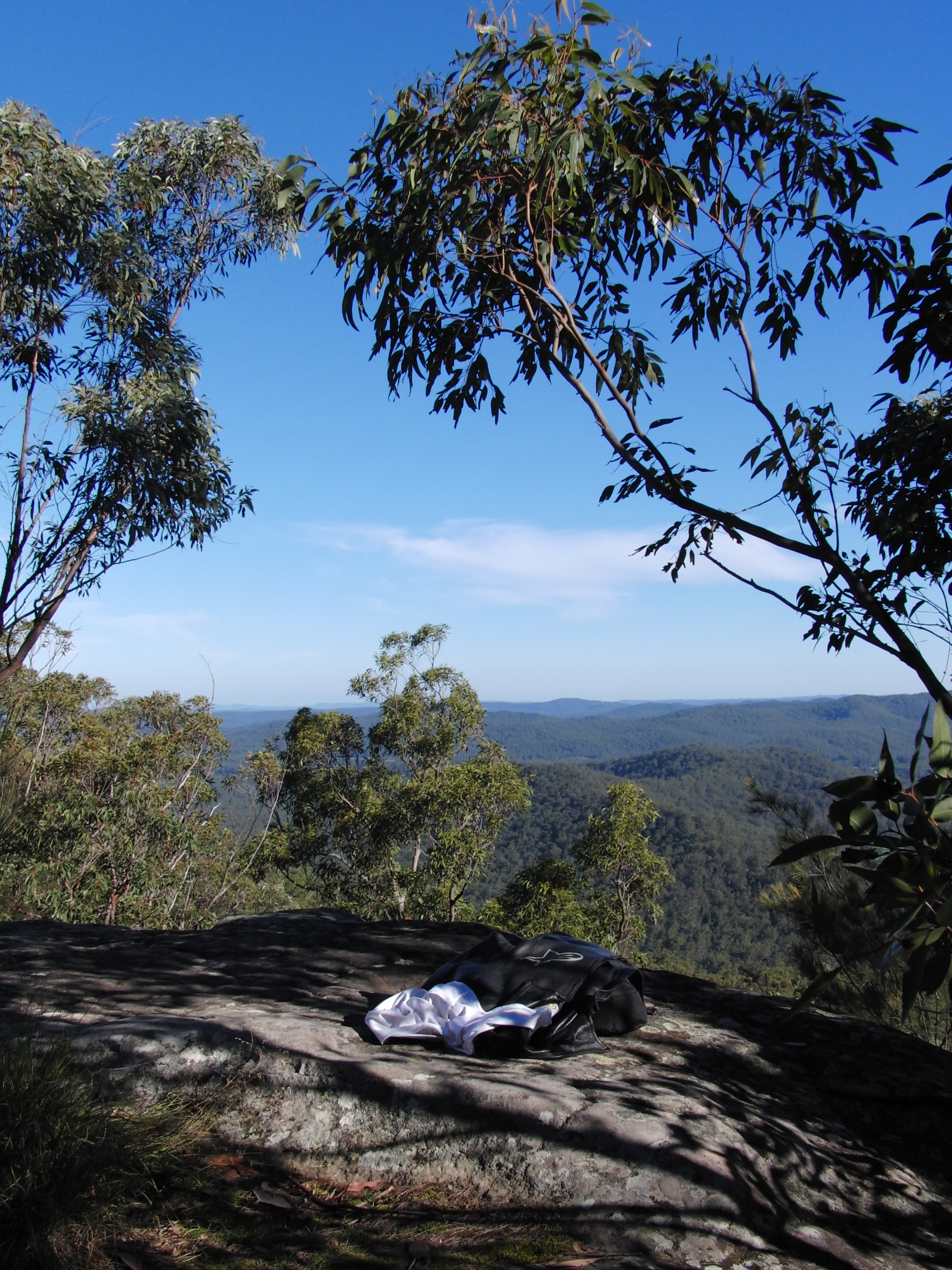
Yet my eyes turned down — and more, I shifted to the edge precarious of my rock — to track the sound. From the south east, moving westwards, on the dead end mountain road directly below the ridge line on which I sat.

CIMG2152
I paused, pleasantly distracted, only long enough to absorb it. To appreciate, to embrace the experience of it. Such a distinct sound, rhythmic, and melodic, on a breathless day. So near, and so clear. That is, in contrast to the faint hum of traffic on the freeway, some five kilometres distant as the crow flies. Or the soft crunch of rubber on gravel, travelling over from the northeast, as and when a rare vehicle descended the main forest road. This horse and its rider — for a rider such a well shod, and deliberately paced horse must have — the nearest human contact I had sensed for some hours.

Human? I had no cause, and gave no pause, to entertain this question. Not at the first.

Very shortly after, I heard it again. Above, and behind me. Even closer this time. For now, the horse’s hooves beat out their rhythm on the same dead end road I had travelled, to reach my present place of rest. Cantering, then trotting, cantering, then trotting again. Drawing ever nearer, now from the north east westward.

I paused once more, to welcome the sound. To let it flow through me — how pleasantly — as I embraced it.

For a moment, I wondered if the horse and rider might come all the way to the very end of the road, and spy the narrow single track behind the public lookout’s safety rail, leading the hundred or so metres down along the ridge line to my hidden position.

But then, having again accepted the appearance of the horse and its rider, my attention returned again, to my former activity. Only some time later did it occur that these twin appearances were not so easily explicable.

This was not the only welcomed, and yet, in hindsight, strange, happening of the afternoon. There was also, shortly after, a gathering. A drawing extraordinarily near to me, of the birds.

It is, of course, not unusual for tiny birds to appear nearby, flitting, peeping, and chirping, chasing insects through the trees surrounding my favouritely frequented rock of seclusion. As I sit or lie reading, meditating, contemplating, or (sometimes) dozing, my stillness draws little notice, gives no cause for alarm. Birds will often alight in trees close by, to be startled sometimes by my movement in turning towards their sound; at other times, confident to return my gaze briefly, before moving on.

But never before have so many, come so near.

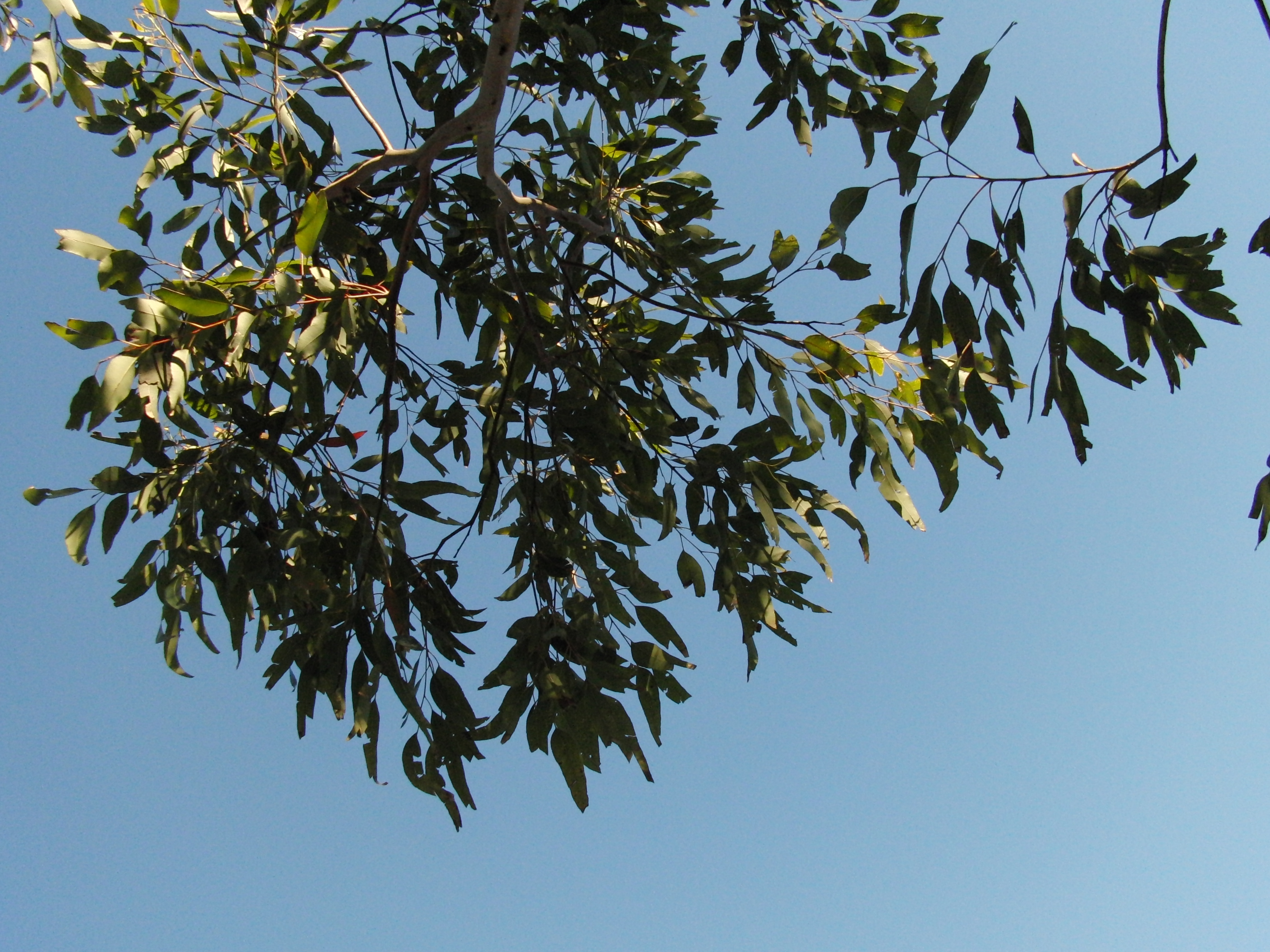
A mere handful of feet from where I rested, indeed, just above my head, almost within arms reach, a branch overhangs.

CIMG2141
Presently, after the sound of hoof beats behind me again disappeared, just as suddenly as they had appeared — how, and where, questions not yet occurring — a tiny bird drew my eye, darting in for landing, in a tree just in front and to my left. No more than three or four metres away. A Scarlet Robin, I believe. Black, with white, and a bold red breast. Not unlike the colours of Psalmistice.

Shortly it departed, only to be replaced by others, of different kinds. Variously, they perched briefly to observe me, before merrily flittering from branch to branch. Perhaps, or so it seemed, sporting with each other, while occasionally performing remarkable aerobatic feats in pursuit of near-invisible black dots of flying food. And all this immediately before me; not beside, or behind. In the stillness of this day, with rarely a hint of softly disturbed air, and my senses acutely tuned, every movement I could hear.

After some time enjoying this surge of feathered activity, I felt a certain compulsion. To lay down, rest, and look up. I reclined on the rock, the back of my head nestled on the thick protective sleeve of my motorcycle jacket.

Almost immediately, a little nondescript bird alighted in the leaves just above my head.

CIMG2149
For some time it moved about in the leaves above, looking at me, and the world around. And once again, when it moved on, others immediately came to take its place. Most spectacularly, a pair of colourful Eastern Spinebills, who darted and hovered about the foliage, so nearly within touching distance that I felt it almost possible to reach up, and gather them in hand.

Shortly after their departing, the keenness of my interest in bird appreciation beginning to wane, I turned to reading the book I had brought along. A book loaned to me, with enthusiastic endorsement, the previous day. A book about angels.

In time, I came upon a discussion of the biblical tale of Elisha’s servant. When the king of Syria sent “a great host” to capture the prophet Elisha, his servant, on seeing the army surrounding the city, was stricken with panic (2 Kings 6:8-17):

And his servant said unto him, Alas, my master! how shall we do?

And he answered, Fear not: for they that be with us are more than they that be with them.

And Elisha prayed, and said, Lord, I pray thee, open his eyes, that he may see.

And the Lord opened the eyes of the young man and he saw: and behold, the mountain was full of horses and chariots of fire round about Elisha.

Earlier in his life, Elisha had experienced something very similar, when his own master, the prophet Elijah, had been taken up into heaven (2 Kings 2:1-12):

And it came to pass, as they still went on, and talked, that, behold, there appeared a chariot of fire, and horses of fire, and parted them both asunder; and Elijah went up by a whirlwind into heaven.

And Elisha saw it, and he cried, My father, my father, the chariot of Israel, and the horsemen thereof. And he saw him no more: and he took hold of his own clothes, and rent them in two pieces.

Now, shortly after the event where Elisha’s panic-stricken servant was enabled to see the “horses and chariots of fire round about”, who were there waiting to protect them, these strange horses make yet another appearance.  The Syrian army had moved on to lay siege to the city of Samaria. Eventually, four lepers decided it would be better to go to the Syrians and hope for mercy, than to remain in the city and surely die of hunger (2 Kings 7:3-7):

And they rose up in the twilight, to go unto the camp of the Syrians: and when they were come to the uttermost part of the camp of Syria, behold, there was no man there.

For the Lord had made the host of the Syrians to hear a noise of chariots, and a noise of horses, even the noise of a great host: and they said one to another, Lo, the king of Israel hath hired against us the kings of the Hittites, and the kings of the Egyptians, to come upon us.

Wherefore they arose and fled in the twilight, and left their tents, and their horses, and their asses, even the camp as it was, and fled for their life.

These accounts call to mind another, from the visions of St. John (Revelation 19:14):

And the armies which were in heaven followed him upon white horses, clothed in fine linen, white and clean.

Later in the afternoon, while meditating peacefully, all of a sudden, a number of questions began to dawn on me, concerning the hoof beats heard previously. Not only questions, but also, observations.

I know every road in this neck of the woods.

When I first heard the horse, it was moving towards the dead end of the road below the ridge line. But I never heard it returning again. Rather, the sound had stopped somewhere immediately in front, perhaps slightly to the right of and below my position. At the time, I did not really think anything of it, perhaps assuming it had simply stopped somewhere to rest.

Did the horse remain somewhere down there all afternoon? If it moved on, how could I not have heard it?

I could clearly, though faintly hear the hum of freeway traffic some five kilometres away.

And yet, the sound of those hoof beats had appeared quite suddenly to my awareness, ringing out loud and clear, only when it was, to my best estimate, no more than 500 metres distant, at about the near 180* turn in the lower road, where it rounds the end of the ridge line. If it had come along that road, then how could I not have heard it to my left as well, as it travelled along the other side of the same ridge line, no further distant than when I heard it so clearly?

Then too, what of the horse behind me? Its sound had also appeared very suddenly to my awareness; loud and clear, and very near. At other times, I could hear the sound of tyres crunching on gravel on the main forest road, perhaps a full kilometre away, from which both the lower ridge line road and the upper road both diverge. So, how could I not hear the horse approaching from behind, on the upper road, until it was, again, within no more than 500 metres of where I sat?

Moreover, I did not hear the horse below departing. And the time interval between hearing both sounds, was, I am sure, much too short for even a galloping horse to traverse all the way back along the lower road, ascend the main forest road, and then traverse in along the upper road behind me. Much less, do so silently.

Was there a second horse, then?

I have visited this place countless times, and never seen nor heard a horse there before. It was a Wednesday, not a weekend. What odds an equestrian, much less two, separately, choosing to ride way out here in the middle of the week?

And if, by some chance, there were two horses, then why did each of them — or their riders — just happen to alternate between a near identically-sequenced canter, then trot, canter, then trot, and this only upon reaching a position that, again, just happened to be so nearly equidistant from my position, and nearing the dead end of each road?

I know this place, this area, much too well to be easily self-deceived.

Indeed, so intrigued was I, as to just how these events might be rationally explained, on the way home that evening I used my motorcycle’s trip meter to go out of my way, and confirm the distance between where I had been sitting, and the approximate position on the low road where I first heard the sound of hoof beats approaching. Some four point five kilometres.

No lone horse that I know of could have travelled that distance, in that time interval. Much less in silence, for most of its journey.

There are no alternate roads, or trails. Certainly, none that a horse could travel over — and up — more quickly, and silently.

And if two horses, then why did I not hear either of them depart? Indeed, when these thoughts began to dawn on me, I left my rock for a time, to walk back up the ridge line to the upper road, just to see if a horse was there. Later, on departing, I spent some time riding around looking for any horses or equestrians who may have been about.

I was alone.

There is no doubt that I was fully awake, at all times, throughout the afternoon.

I did not begin to read about angels and “horses of fire” until after hearing these sounds, and in the moment, thinking nothing of them.

What did I hear?

And what of all those birds, gathering so near?

I cannot say.

Strange days indeed.


Standard
General

To be near, is enough

There was a time when I found comfort in keeping a hand written diary, a record of my solitary reflections. These diaries — 200 page A4 spiral bound notepads — had steadily mounted up into a not insignificant pile, until more recent times, when alas, this, among other good and useful habits, found occasion to go on the wane.

Today, having a view to reviving my past practice, I rescued the last of these diaries. Here following is the second-to-last entry:

I am at “my” spot, near [withheld for privacy] Lookout. On “my” rock.

I have been blessed in recent days, while reading St John of the Cross’ Ascent of Mount Carmel. It has helped me to “see” several things, that have hindered me in recent years.

The biggest insight, being that the sense of being “idle” that comes (often, to me) when committed to the doing nothing, the isolation, that I (and many/most mystics) have found necessary to living a life “right” with God, is not truth. It is temptation; a hindrance; a distraction. It is not true. Far from being “idle” or “lazy”, being in this state is simply ceasing from “my” works, and so allowing God full access to do His work (cf. pp 166-170).

Today, I’ve not yet begun to read more. But I am convicted of an idea, regarding love. For God, or indeed, for others.

Just as, when one loves a woman, one is content just to be NEAR her … indeed, that is what one desires, simply, above all … then in this same way, we can see that there is no need to “know” / understand God (an impossibility, in any event). There is no need to be able to describe the experience, to be able to define or label it. It is enough, just to be near Him.

I sense there is much more to be gained, in comparing (true) earthly love between M & F, and the correct way to understand … in greatest simplicity … the essence of “having a relationship” with God.

It is enough to sit silently with the One we love on earth. How much more The One in heaven.

Standard
General

How to love

In the past, I have not really understood how, exactly, it is possible to “love God”.

In simple terms.

How can you “love” some thing that is — by popular assent — beyond the reach of our five senses? Is infinite, eternal, ineffable, and unknowable? How can you truly love some thing, some One, that you do not “know”, cannot see, or touch?

Now, I believe that I do understand this.

From first understanding exactly what “God” is.

And, what “True Love” is.

True Love is God.

God is True Love.

Ok, so that’s fine, as far as it goes.

In a circle.

But how exactly do you “love” Love?

How does that help us understand how to manifest True Love? Whether to God, or, to our neighbour?

What, exactly, does God / True Love actually do?

Yield.

yield  (yēld)

v. yield·ed, yield·ing, yields

v.tr.

1.

a. To give forth by or as if by a natural process, especially by cultivation: a field that yields many bushels of corn.
b. To furnish as return for effort or investment; be productive of: an investment that yields high percentages.

2.

a. To give over possession of, as in deference or defeat; surrender.
b. To give up (an advantage, for example) to another; concede.

v.intr.

1.

a. To give forth a natural product; be productive.
b. To produce a return for effort or investment: bonds that yield well.

2.

a. To give up, as in defeat; surrender or submit.
b. To give way to pressure or force: The door yielded to a gentle push.
c. To give way to argument, persuasion, influence, or entreaty.
d. To give up one’s place, as to one that is superior: yielded to the chairperson.


To love God, is to yield.

To give up.

To give way.

To love some one in this world — to manifest the True Love that is God to them — means to yield to them.

To give up.

To give way.

Like the ocean. Giving way, yield-ing, to the movement of a wave.

It is that simple.

And that difficult.

Because Self does not like to yield.

Self is a force opposite to Love.

Self resists giving in.

It is clear then, why “Self” must “die”.

So that True Love can be seen.

Standard
Poetry

Love is

In my first poem titled Returning, I described the Passions as being like heat and cold. The changing of the seasons. The rising and falling heat of the day. And then, the consequence:

For Passion’s heat will always fade,
Chill to the bone, and feelings jade,
Cold, exhausted, insecure,
I did not know how to fly at all.

Longed for warmth, looked for a mate,
Thinking to share a happy Fate,
Bonds of Passion I explored,
And found they do not fly at all.

For how can two together fly,
When in the spell of lovers’ guise,
Unbalanced forces are ignored,
And neither half can fly at all.

Two Selfish Passions bound will rise,
Until the weaker falls behind,
Or stronger leaves for different score,
And broken wings don’t fly at all.

That’s why they say we fall in love,
It’s not Love True they’re speaking of,
But Passions bound in Selfish thrall,
They do not know how to fly at all.

I submit to you my view, that our most common conceptions of love, are all mis-taken. That all the many influences that teach us what love is, have taught us a-miss.

True Love is not complicated. It is not confusing, or frustrating. It is not hard to find. It can not, ever, be lost.

True Love is, simply, not what we think it is.

Consider our experiences of “love”. From the very beginning.

I see some one. In the seeing, I find that one “attract-ive”.

But what does that mean?

My eyes only “see” Form. Or, more correctly to say, my eyes receive light. The visible light waves that are reflected from the surface. My mind interprets the signals sent from my eyes as Form (including Colour).

What my mind then “sees” — or, more correctly to say, conceives — is an image. In the imagin-ation. A re-presentation, of the meaning that one’s Form has to me.

Beauty. Strength. Youth. Experience. Softness. Virility. Fertility. Power. Warmth. Excitement. Laughter. Comfort. Togetherness. Security. Fulfillment. Success. Status. Completeness. Acceptance. Honour. Respect. Approval. Et cetera.

How does my mind do this? By comparing the Form I “see” — in all its many splendoured details — with memory. With stored information. Stored understandings. Stored experiences. Stored inferences. Stored “knowledge”. Stored beliefs. Beliefs about what certain Forms represent.

When I “see” some one, and in the seeing, experience a strong feeling of attraction within me, the Falling has nearly begun.

What I am really attracted to, is not the Person, the Being with-in the Form. What I am really attracted to, at the first, is what their outward Form, and, their Form of actions, appear to represent, in relation to my beliefs. And because I already hold the belief that some thing like this image, this re-presentation of meaning, is desirable, the inevitable follows.

I desire to have what I “see”.

I begin to fall in “love” … in my imagin-ation … not with what I have actually seen; a mere physical Form, with all its accoutrements. I begin to fall in “love” with what my mind imagines that I have seen; a physical manifestation, an embodiment, of preferred beliefs.

Some of these preferred beliefs are, of course, all very good and well and, it may even appear to be, timeless. Alas, many more are fickle, only lasting as long as the most recent preferences in what others may have, temporarily, declared to be fashionable clothing.

It is in the fertile ground of our desire to have — that is, to possess, to own — a physical embodiment of an image, a representation, of those ideas that we have come to believe to be desirable, that all the temporary joys and unnecessary sufferings of illusory “love” are nourished and bear fruit.

I understand that you may not like to read this truth. You may feel a certain discomfort. A resistance. A desire to defend. But what is it really, that you are defending?

You may prefer to romanticise the common perception of “love”. You may prefer to say, to believe, that this desiring is not a desire to have, to possess, or to own. That it … yours … is a pure and true and good desire, to be “one” with the object of your “love”.

I say to you, that this “love” of which you speak, this desire, to be oned with the object of your attraction, is a desire born not of True Love, but of selfishness.

It is a desire to be oned so that, in becoming one, “I” may gain, and never lose, the embodiment of meaning that “I” desire to have.

This is not True Love.

Let us consider what True Love is. By going back to the beginning, of All Things.

By most accounts philosophical, scientific, and religious, in the beginning there was NoThing.

The “void”. The “singularity”. The “One”.

“God”.

In other words … by most accounts … “No Thing”.

Out of this “No Thing”, all things came in-to Being.

That is to say, the “No Thing” gave up, or yield-ed, of Its-Self; and so, All Things came to be.

All “things” are, therefore, a result of movement.

A giving, a yielding movement.

A movement in, and of, the Rest.

A movement of, and with-in, the Infinite “No Thing”.

Like the giving, yielding movement of, and with-in, a Great Ocean.

Movement that we may “see” as waves, but yet, remain still a movement in, and of, that Great Ocean:

This, then, from the Beginning, is True Love.

It is how we can know, understand, and recognise True Love.

True Love is a capacity. A potentiality.

It is a Rest.

It is an Infinite Capacity, that is Willing to give.

To yield.

True Love is Passibility. A capacity to “suffer”.

It is a capacity to be moved, in one’s self, and away from one’s self. That is, to be moved away from one’s own centre of being. A capacity for giving, for yielding movement, in sympathy with and for the existence, the movement, the life, of an Other.

True Love is a capacity to be a ground, a source, a potential, of and to and for All Other Things. Without distinction. Without prejudice.

True Love must be, therefore, humble, and meek.

It does not desire to have. To possess. Or to gain.

For it already has, and possesses, and has gained, All Things.

It is the Infinite, Eternal NoThing from which All Things are born.

True Love, then, being the NoThing, can most easily be seen in this world of things, through our embodiment, our manifestation of It.

That is to say, through our willingness to allow our Self to become, as it were, NoThing.

For why?

So that the NoThing that was from the beginning, might again be seen, by others — in and through and to you — as Being the All (or NoThing) that is in All.

This is how we know that True Love is not hard to find, and can not, ever, be lost.

Because “It” is the Source, the Beginning, the Essence of All Things.

It is Infinite, Eternal, and everywhere waiting.

It is with-in you.

Standard
General

The best part

It occurred to me this morning, that the famous critic of religion, Richard Dawkins, and so many others too, choose to behave in a manner that is not pragmatic.

Whether by accident, or by design, the obvious truth is that they are, inevitably, perceived to be attacking religion itself.

I think they would do well to start over. To begin again, by valuing the pearl of wisdom passed down by my sagacious Nanna:

A man convinced against his will,
is of the same opinion still.

‘Religion’ has always been with us. Throughout recorded human history. That is what the evidence tells us.

A practical man, then, might be inclined to accept the likelihood that religion, in one form or another, is here to stay. And try instead, to make the best of it.

Perhaps the secret to resolving concerns about religion, and religious difference, is not to be found in trying to discredit religion. Or worse, in suggesting, or implying, that any one religion might be superior, or inferior, more “right”, or less “right”, than another.

Perhaps the secret — the secret to practical conflict resolution — is to be found in identifying that which is truly good, in each religion. And then, encouraging more of the adherents of that religion to keep it simple, by focussing their attention only on “the best part”.

Of their own religious tradition.

It seems to me that possibly the greatest danger facing humanity in recent times, is the appearance of ever growing tensions between the “Christian” West, and the “Islamic” East.

A solution, I suggest, is not to be found in the use of weapons, whether physical, philosophical, or legislative. On the contrary, if you ponder it carefully, along with my Nanna’s pearl of wisdom, you will see the obviousness of the truth. That all of these serve only to increase tensions.

It seems to me that the Christian mystical tradition, and the Islamic mystical tradition called “Sufism”, both share that which is essential to the goal of peace and love within. And so without.

A central theme, a continuous focus, on Oneness.

On the experience of being one with — of being in — the Presence of God.

Not just after (physical) death, in a placed called “Heaven”.

But here and now.

It is not possible, or so it seems to me, for any soul to truly glimpse the path to Oneness, to have an experience of Oneness — that is, to feel, if even only for a moment, a true sense of connection, with that which is Pure, Infinite, Timeless, Everywhere — and not to want for more of that connection.

And so, inevitably, in consequence, to also feel the need, the desire, to feel a greater, and not a lesser, connection to every other creature.

I can quite understand why it is that those who focus their time and commitments upon the “fundamental”, doctrinal, and essentially hierarchical traditions of their particular religion, have often exhibited a tendency to downplay, to distract, to encourage others to look away from mysticism.

In a very real sense, each religion’s own mystical tradition represents their greatest danger. That is to say, a danger to that religion’s temporal place of power in, and over, the lives of its subjects. The danger is that it comes from within.

Once a soul, whether self-identifying as “Christian”, or “Muslim”, begins to see that the central truth of their own religious tradition is found in, and through, an inner movement towards a deep and personal sense of oneness with “their” God — who, they soon begin to both feel and Know, is not “their” God only, but the God who is of, and through, and in All, the God who “lights every man who comes into the world” — inevitably, there is no longer any need felt for human authority. From someone to instruct, or command them, to be a “channel”, or “connection”, between them and their God.

For now this person has begun to Know the inner truth. The best part, of their own religious tradition.

Now it came to pass as they went,
that he entered into a certain town:
and a certain woman named Martha,
received him into her house.

And she had a sister called Mary,
who sitting also at the Lord’s feet,
heard his word.

But Martha was busy about much serving.
Who stood and said:
Lord, hast thou no care that my sister hath
left me alone to serve?
speak to her therefore, that she help me.

And the Lord answering, said to her:
Martha, Martha, thou art careful,
and art troubled about many things:

But one thing is necessary.
Mary hath chosen the best part,
which shall not be taken away from her.

One thing is necessary.

The best part.

To sit, and listen.

It’s not complicated.

Standard
Motorcycles

Old school

“What are the three bowsers for?”

The muffled voice came from behind my right shoulder. A snowy-haired man, of average frame, perhaps 75 years or more, bearing a vague expression, seeming somewhat nervous, uncertain in his gait, and apparently struggling to catch up with my longer yet slower strides, gestured in the direction of my Harley-Davidson resting alongside bowser number five.

Removing one of my ear plugs to hear him more clearly, I smiled, in part to put him at ease, and in part simply because his face was pleasing, before briefly explaining that the numbers written on each of the nozzles — 100, 95, and 91 — represent that fuel’s octane rating; further, that “E10” written on the nozzle represents 10% ethanol, and, what is the relevance of all these to various kinds and ages of engines.

Seeming satisfied with this, the old man mumbled something about having bought his car “about 10 years ago”, turning to point back towards a dark blue Toyota Camry parked across the way at bowser number two, then simply doddered off in its direction without further word.

This little interaction was the highlight of my day. It caused me to feel a long lasting surge of inner happiness, and satisfaction.

And that joyful feeling prompted a time of reflection, as I rumbled homeward bound.

It is truly, such a wonderful thing. Simply to be able, to help someone else.

To be of service.

Often times, helping can entail little more than the sharing of information gained, not through any great effort or expense, but simply from having been blessed with experience of living.

Life experience.

Indeed, it was this somewhat paradoxical aspect of my interaction with the old man that most provoked my contemplation. Because here, a younger person was able to help an older one, by virtue of having and sharing basic information that the older man had not, apparently, otherwise gleaned, despite having many more years of life experience.

For some time now, I have lamented the ever-growing encouragements to worship of youth. There are, I think, far too many harms arising from such worship, to even begin to explicate them in this, what was intended to be, just a little anecdote.

Even more so, however, I have lamented the coincident — or perhaps, consequent? — ever-growing encouragements to loss of respect, of reverence, for the hoary head of experience.

You see, I really like old people. Always have done.

I see every old person as a fascinating mystery, and one holding great opportunity. A rich beneficiary, of a great and limitless universal trust fund, established for all of us, by a wonderful benefactor named Time. A beneficiary whose relative riches have been increased in proportion, more or less, to the Time they have known, loved, and held on to. A veritable storehouse of unique and rare pearls of simple wisdom, and little glittering jewels of useful knowledge. Received through Time, and now hidden amongst the clutter of foolishness and falsehoods, and the cobwebs of forgetting; which is only human, of course. A treasure trove of gems, gathered together, one by one, from across their ages, or passed down from their ancestors’ ages.

Some, or many, of these riches may soon be lost to us. Never to be discovered, by you or I, through our own experience of Time.

Unless we ask for directions.

Standard
Mysticism, Nature

180 +/- 180

Look now forward, and let be backward;
and see what thee faileth,
and not what thou hast,
for that is the readiest getting
and keeping of meekness.

It occurred to me today, while reading the 14th century Christian mystical work The Cloud of Unknowing, that most of us see things exactly 180 degrees out of whack.

On two levels.

It also occurred to me that these two levels are, and should be, naturally, 180 degrees out of whack to each other.

In the quote above, the author of The Cloud is speaking of things spiritual, or “ghostly”, as he prefers to say.

It seems to me that, in ghostly things, too many of us have reversed his instruction, acting as though this were our mantra for personal virtue:

See what thou hast,
and not what thee faileth,
for that is the readiest getting
and keeping of Pride.

On the other hand, in physical things — whether possessions, or body image — most of us act as though we have applied his “ghostly” instruction to the wrong level, making this our rule for the world of “things”:

See what thee faileth,
and not what thou hast,
for that is the readiest getting
and keeping of Discontent.

Would it not be far better, to turn our physical and our “ghostly” worlds, up-side down and down-side up?

It seems to me that both our worlds would be enhanced, if we first chose to accord our ghostly (inner) world with the instruction:

See what thee faileth,
and not what thou hast,
for that is the readiest getting
and keeping of Humility.

And our physical (outer) world would be enriched, if we chose to act always according to this instruction:

See what thou hast,
and not what thee faileth,
for that is the readiest getting
and keeping of Contentment.

Where we choose to look — to focus most of our day’s attention — seems to me to be the key.

The key to bringing our upper (inner) and lower (outer) worlds into natural alignment.

It also seems to me, that what we should look at — and not look at — in our higher (“ghostly”) world view, needs to be 180 degrees opposite to our lower (physical) world view.

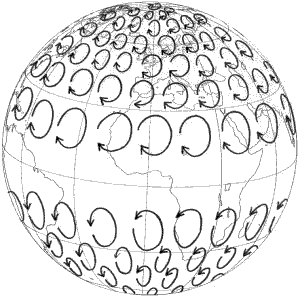
Just as Nature urges free air to “look now forward, and let be backward” in opposite directions, above and below the equator.

20050812071235!Coriolis_effect14

And with increasing gusto, the higher (or lower) one moves towards the poles.

Spiritual:  See what thee faileth, and not what thou hast…

Physical:  See what thou hast, and not what thee faileth…

Standard